
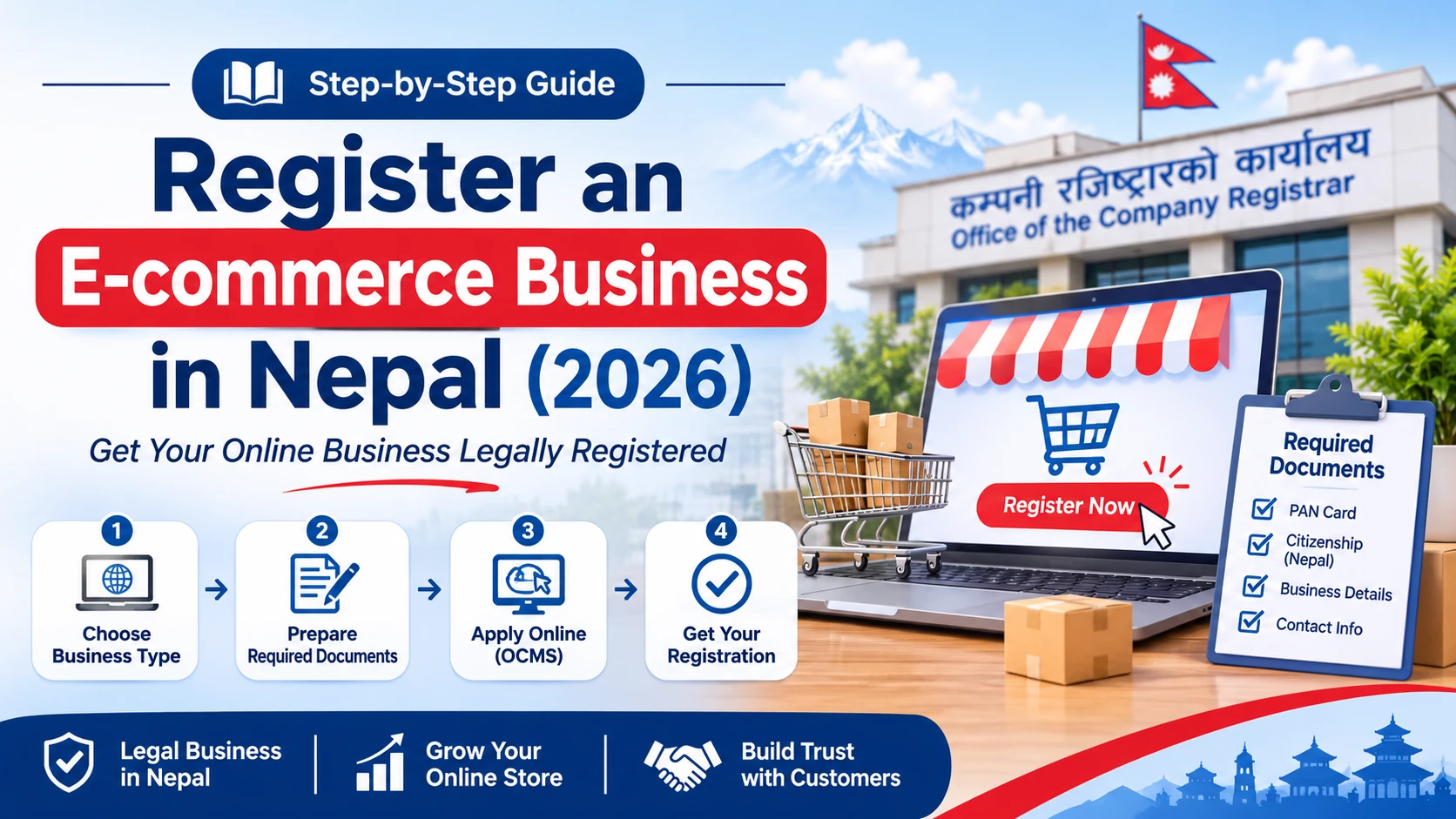
Starting an e-commerce business in Nepal can be an opportunity for entrepreneurs who want to sell clothing, electronics, groceries, handmade products, cosmetics, digital products, or other goods online. You can operate through your own website, a mobile application, or an online marketplace, depending on your business model.
However, creating a website or a Facebook and Instagram page does not automatically make your business legally registered. You may need to register the business, obtain tax registration, complete the applicable e-commerce listing or registration requirements, and comply with consumer protection and other relevant laws.
Nepal's Electronic Commerce Act, 2081, is particularly important for businesses selling goods and services electronically.
This guide explains the general process of registering an e-commerce business in Nepal, the documents you may need, the relevant government offices, possible costs, tax obligations, and common mistakes to avoid.
For related steps, see the company registration guide and the PAN and VAT registration guide.
Last reviewed: 27 October 2026
*Important: Government procedures, fees, tax thresholds, and online filing systems can change. Confirm the latest requirements with the relevant government authority before submitting an application. This guide is for general information and is not a substitute for legal or tax advice.*
What Is an E-commerce Business in Nepal?
An e-commerce business is a business that sells goods or services through electronic platforms. These platforms may include websites, mobile applications, online marketplaces, and other electronic channels covered by applicable law.
Examples include:
- Selling clothes, shoes, and fashion accessories through an online store.
- Selling mobile phones, computers, and electronic accessories.
- Operating an online grocery or food-ordering business.
- Selling locally manufactured products, handicrafts, or agricultural products.
- Providing eligible digital products or services online.
- Operating a marketplace that connects buyers and sellers.
The legal requirements depend on what you sell, how the business is organised, whether you import products, and whether you operate your own store or a marketplace.
For example, a business importing electronic products may have additional customs and product compliance obligations. A marketplace facilitating sales by third-party sellers may have responsibilities different from those of a business selling only its own inventory.
Which Law Regulates E-commerce Businesses in Nepal?
The main legislation to understand is the Electronic Commerce Act, 2081 (2025), alongside other applicable company, tax, consumer protection, and sector-specific laws.
The Electronic Commerce Act establishes a legal framework for electronic commerce. Depending on the business and its activities, relevant obligations may include business identification, required registration or listing with the competent authority, disclosure of seller and product information, transparent pricing, order handling, consumer protection, and complaint resolution.
Other laws and requirements may also apply, including:
- Companies Act and applicable company-registration rules.
- Private firm or partnership registration requirements, where applicable.
- Income tax and VAT legislation.
- Consumer Protection Act, 2075.
- Electronic Transactions Act, 2063, where relevant.
- Foreign investment, import, customs, food safety, pharmaceutical, or other sector-specific rules, if applicable.
Do not assume that registering a company alone satisfies all requirements under the Electronic Commerce Act.
Where to verify: Department of Commerce, Supplies and Consumer Protection — https://doc.gov.np/
Check the current Act, implementing rules, official notices, and the applicable e-commerce registration or listing procedure. Confirm which authority and portal handle applications for your particular business.
Choose the Right Business Structure
Before applying for registration, decide how you want to operate the business.
Option A: Sole proprietorship or private firm
A sole proprietorship is often suitable for an individual starting a relatively small online store.
Potential advantages include simpler ownership and management and fewer corporate formalities than a company.
However, a sole proprietor generally has personal liability for business obligations. The exact registration route depends on the nature of the business and the applicable local or provincial rules.
Option B: Partnership firm
A partnership may suit two or more people who want to operate an online business together.
Partners should establish clear arrangements covering capital contributions, profit sharing, responsibilities, decision-making, and the consequences of a partner leaving.
Register the partnership with the relevant authority and prepare the required partnership documentation.
Option C: Private limited company
A private limited company may be appropriate if you plan to expand, bring in investors, employ staff, build a marketplace, or enter into larger commercial agreements.
Company incorporation is handled through the Office of the Company Registrar.
Official website: https://ocr.gov.np/
A company is a separate legal entity, but incorporation creates additional compliance obligations, including applicable company filings and tax requirements.
Which structure should you choose?
| Business situation | Structure to consider |
|---|---|
| Small online store operated by one person | Sole proprietorship or private firm |
| Online shop owned by several partners | Registered partnership |
| Startup expecting investment or significant expansion | Private limited company |
| Marketplace connecting multiple sellers | Company structure may be suitable; assess legal obligations |
These are general considerations, not mandatory structure assignments. Verify eligibility and registration requirements before deciding.
Step-by-Step Process to Register an E-commerce Business in Nepal
The following steps provide a practical starting point. Some procedures may run in parallel, and the precise sequence depends on your business structure and the current government process.
Step 1: Finalise your business name and model
Decide what your business will sell and how customers will place orders.
Before registering, prepare the following:
- Proposed business name.
- Description of goods or services.
- Business address.
- Names and details of owners, partners, or directors.
- Expected sales channels.
- Information about suppliers and product sourcing.
- Whether you will sell your own products or host third-party sellers.
If you intend to establish a company, check name availability and follow the Office of the Company Registrar's name-approval process.
Do not assume a company name, domain name, social media username, and trademark are interchangeable. Each serves a different purpose.
Step 2: Register the business with the appropriate authority
The correct authority depends on your chosen structure and the applicable registration rules.
For a private limited company:
- Visit the Office of the Company Registrar website.
- Review the current company incorporation procedure.
- Reserve or obtain approval for the proposed name, as required.
- Prepare the memorandum of association and articles of association.
- Submit the required incorporation application and supporting documents.
- Pay the applicable government fees.
- Respond to any requests for correction or additional information.
- Obtain the company registration certificate once approved.
Official website: https://ocr.gov.np/
For a sole proprietorship or private firm:
- Identify the authority responsible for registering your type of business.
- Confirm whether registration is handled by a provincial or local industry or commerce office, or another competent authority.
- Prepare the required identity, address, and business documents.
- Submit the application and pay the applicable fee.
- Obtain the relevant registration certificate.
For a partnership:
- Prepare a partnership agreement.
- Confirm the responsible registration authority.
- Submit partner details and the required business documents.
- Pay the applicable fee and obtain the registration certificate.
Registration procedures differ, so use the official checklist for your business category rather than relying on a generic list of documents.
Step 3: Obtain PAN registration
A Permanent Account Number (PAN) is an important part of tax compliance for businesses operating in Nepal.
After establishing the business, apply for the appropriate PAN through the Inland Revenue Department's current registration process.
Official website: https://ird.gov.np/
The required documents depend on whether the applicant is an individual proprietor, partnership, or company.
Typical documents may include:
- Business registration certificate.
- Citizenship or other accepted identity documents.
- Company incorporation documents, where applicable.
- Details of owners, partners, or directors.
- Business address and contact information.
- Other documents requested by the Inland Revenue Department.
Follow the current IRD instructions for online or in-person registration.
Important: PAN registration does not automatically mean that you are registered for VAT. These are separate tax matters.
Step 4: Determine whether VAT registration is required
Not every online seller has the same VAT obligations. Your requirement depends on the nature of the business, taxable turnover, applicable thresholds, and any mandatory-registration provisions.
Before starting sales, establish whether your business must register for VAT.
Consider the following:
- What goods or services are you selling?
- Are the sales taxable or exempt?
- What is your expected annual taxable turnover?
- Does a mandatory-registration rule apply to your activity?
- Are you importing goods or operating under a special tax arrangement?
Do not rely on a single turnover figure found in an old blog post. Thresholds and exceptions can change, and certain activities may have different requirements.
Contact the Inland Revenue Department or a qualified tax professional if your VAT position is unclear.
Official website: https://ird.gov.np/
Once registered, comply with applicable VAT invoicing, return filing, recordkeeping, and payment obligations.
Step 5: Complete the applicable e-commerce registration or listing requirements
This is a key step for an online business.
The Electronic Commerce Act, 2081, introduced a legal framework specifically addressing electronic commerce. Business registration, PAN, and VAT registration, where applicable, should not be treated as replacements for any separate e-commerce registration or listing obligation.
To establish what you must do:
- Visit the Department of Commerce, Supplies and Consumer Protection website.
- Locate the current Electronic Commerce Act, rules, notices, and official application instructions.
- Identify the applicable registration or listing category for your business.
- Confirm whether the application must be filed through a designated online portal or another official process.
- Prepare the requested business and platform information.
- Submit the application and supporting documents.
- Pay any applicable fee, if prescribed.
- Keep the official acknowledgement, registration or listing number, and approval records.
Official website: https://doc.gov.np/
Depending on the applicable procedure, you may be asked for information such as:
- Legal business name and registration number.
- Business address and contact details.
- PAN or VAT details, as applicable.
- Website or application address.
- Information about the person responsible for the platform.
- Product or service categories.
- Customer complaint and contact arrangements.
- Other information required by the competent authority.
This is an indicative list, not a guaranteed official checklist.
Before publishing this guide as a definitive registration walkthrough, verify the current application portal, required documents, fee, processing time, and any applicable transition or deadline provisions directly with the Department. Do not advertise a third-party website as the official registration portal unless its status has been confirmed.
Step 6: Register with the local authority if required
Depending on your business activity and location, local business registration or municipal requirements may apply.
Contact your municipality or rural municipality and explain whether you will operate from:
- A commercial shop.
- A rented office or warehouse.
- Your home.
- A shared office or fulfilment centre.
Ask about local business registration, business taxes, signage, premises requirements, and any other applicable approvals.
Do not assume that operating exclusively online automatically exempts you from local requirements.
Step 7: Open a business bank account
A dedicated business bank account can help separate business transactions from personal spending.
For a registered company, banks generally request company registration and tax documents, along with identity and authorisation documents for relevant representatives.
For a sole proprietor or partnership, requirements differ by bank and business structure.
Ask your bank for its current checklist before visiting.
Using a dedicated account also makes it easier to reconcile customer payments, supplier invoices, delivery charges, refunds, and tax records.
Step 8: Set up an approved payment method
An online store may accept cash on delivery, bank transfers, QR payments, cards, or supported digital wallets, depending on the provider and business arrangement.
If you want to integrate an online payment gateway, contact a bank or payment service provider authorised to offer the relevant service in Nepal.
Ask about:
- Merchant onboarding requirements.
- Business and tax documents.
- Transaction charges.
- Settlement timelines.
- Refund and dispute procedures.
- Payment security requirements.
- Supported currencies and payment methods.
Do not assume that a personal wallet account is approved for commercial transactions. Confirm the provider's merchant terms and applicable Nepal Rastra Bank requirements.
Official website: https://www.nrb.org.np/
Step 9: Build your website or online selling platform
Once your business and compliance arrangements are in place, prepare the website or application customers will use to shop.
Your platform should clearly explain:
- Business name and contact information.
- Product descriptions and accurate images.
- Total prices and any additional charges.
- Delivery coverage and expected delivery arrangements.
- Payment options.
- Order confirmation procedures.
- Cancellation and return policies.
- Refund arrangements.
- Complaint handling and customer support.
- Privacy and personal-information practices.
Where applicable, provide the registration details and other disclosures required by Nepal's e-commerce law and implementing rules.
A professional-looking website is useful, but design alone does not establish legal compliance.
Step 10: Obtain sector-specific approvals where necessary
Some products and services require additional approvals.
Examples may include:
- Food products and certain food-related businesses.
- Medicines and regulated health products.
- Cosmetics or other regulated products, depending on the product and activity.
- Imported goods subject to licensing, customs, labelling, or safety rules.
- Products subject to intellectual-property restrictions.
- Financial, insurance, or other regulated services.
Check with the competent regulator before selling products that may be restricted or regulated.
For imported goods, confirm applicable customs, import, labelling, and tax requirements rather than assuming that ordinary business registration is sufficient.
Documents Required to Register an E-commerce Business
The exact documents depend on the business structure, registration authority, and current filing procedure.
The following checklist is a preparation guide.
| Document or information | When it may be required |
|---|---|
| Citizenship or accepted identity document | Owner, partners, directors, or authorised representatives |
| Business registration certificate | Tax registration and other business procedures |
| Company incorporation documents | Private limited company |
| Memorandum and articles of association | Company incorporation and relevant subsequent procedures |
| Partnership agreement | Partnership business |
| Business address details | Business, tax, and local registration |
| Passport-size photographs | If requested by the authority |
| PAN details or certificate | Tax and business compliance |
| VAT certificate | If the business is VAT-registered |
| Website or app URL | E-commerce platform registration or listing, where requested |
| Bank account details | Banking and payment-provider onboarding |
| Authorisation documents | Applications submitted through an authorised representative |
| Product or sector-specific approvals | Where required for the goods or services sold |
Keep digital copies of all certificates, application receipts, tax records, and correspondence.
Before submitting an application, compare your documents with the latest official checklist. Missing or inconsistent information can delay approval.
How Much Does It Cost to Register an E-commerce Business in Nepal?
There is no single registration cost for every e-commerce business. The total depends on the legal structure, capital or other fee criteria where applicable, local requirements, professional assistance, and the systems you need to operate the store.
Potential expenses include:
| Expense | What determines the cost |
|---|---|
| Business or company registration | Business structure and applicable government fee schedule |
| Legal documentation | Whether professional drafting or assistance is required |
| PAN registration | Applicable tax-registration process |
| VAT registration | Applicable legal requirements and procedure |
| E-commerce registration or listing | Current official procedure and prescribed fees, if any |
| Local registration | Municipality, location, and applicable rules |
| Domain name and hosting | Provider, domain, and hosting plan |
| Website development | DIY setup, freelancer, or development company |
| Payment gateway | Provider's merchant and transaction fees |
| Inventory and packaging | Products, quantities, and suppliers |
| Delivery and logistics | Courier, location, parcel size, and service terms |
Do not rely on an unverified fixed fee or total startup cost. Check current government fee schedules and obtain quotations from service providers.
Also distinguish between government fees, professional service charges, and ordinary operating expenses. They are not the same.
Tax Rules for E-commerce Businesses in Nepal
Online businesses must assess their tax obligations according to the applicable tax laws, business structure, transactions, and products or services sold.
PAN and income tax
A business should maintain proper sales and expense records and comply with applicable income-tax filing and payment requirements.
The applicable treatment depends on the legal structure and circumstances of the business.
VAT
VAT registration and collection obligations depend on applicable thresholds, exceptions, and mandatory-registration rules.
If your business is VAT-registered, follow the relevant invoicing, recordkeeping, return filing, and payment requirements.
Customs and import taxes
If you import products, you may face customs duties, import VAT, and other requirements depending on the goods and the applicable tariff and regulatory rules.
Business records
Maintain records of:
- Sales and customer orders.
- Purchase invoices.
- Supplier payments.
- Delivery and courier charges.
- Refunds and cancellations.
- Bank and payment-gateway settlements.
- Tax invoices and returns.
- Inventory and business expenses.
Use the Inland Revenue Department's official guidance or a qualified tax professional to confirm the obligations relevant to your business.
Legal Requirements for Operating an Online Store
Registering the business is only one part of the process. Your day-to-day practices should also comply with the relevant laws.
Display accurate business information
Provide the business details and disclosures required by the Electronic Commerce Act and applicable rules.
Customers should be able to identify the seller and find appropriate contact and complaint information.
Show clear prices
Display accurate product prices and disclose applicable delivery fees, taxes, and other charges before customers confirm an order, in accordance with the applicable requirements.
Publish delivery, cancellation, return, and refund policies
Explain when products are dispatched, how delivery works, what happens if an order cannot be fulfilled, and how cancellations or refunds are handled.
Policies should be consistent with applicable consumer protection law. A seller should not assume that a blanket “no refunds” statement overrides statutory consumer rights.
Provide a complaint-handling process
Set up a customer-support email address, telephone number, or other suitable contact channel.
Maintain a process for responding to complaints, incorrect deliveries, damaged goods, payment disputes, and refund requests.
Protect customer information
Collect only the information needed for legitimate business purposes, protect it appropriately, and explain relevant data practices to customers.
Follow applicable privacy, electronic-transactions, cybersecurity, and payment-provider requirements.
Avoid misleading product claims
Product images, specifications, prices, availability, discounts, and advertising should be accurate.
Selling counterfeit goods, misrepresenting products, or making misleading claims can create legal and commercial risks.
Can You Run an E-commerce Business Through Facebook, Instagram, or TikTok?
Selling through social media can be a practical way to test demand before investing in a full online store.
However, using social media does not automatically remove applicable business-registration, tax, consumer-protection, or e-commerce obligations.
If you accept orders through direct messages, social posts, links, or other electronic channels, determine whether your activities fall within the relevant legal definition and requirements.
Keep transaction records, communicate total prices and delivery terms, provide customer support, and verify any required registration or listing with the competent authority.
Do not assume that a small business or a page with few followers is automatically exempt.
How Long Does E-commerce Business Registration Take?
There is no reliable universal processing time for every business structure and registration authority.
The timeline may depend on:
- Whether the proposed business name is available.
- Whether the application is complete.
- Whether supporting documents are consistent.
- The workload of the relevant office.
- Whether additional approvals are needed.
- Whether the e-commerce application requires corrections or further review.
Company incorporation, tax registration, local registration, and any separate e-commerce listing may have different timelines.
For the most accurate estimate, consult the relevant authority's current service standards and application instructions. Avoid relying on a guaranteed number of days unless the authority publishes it for your particular application.
Common Mistakes to Avoid
1. Launching before checking registration obligations. Confirm the business, tax, and e-commerce requirements before commencing operations.
2. Assuming PAN replaces e-commerce registration. Tax registration and e-commerce compliance serve different purposes.
3. Registering the wrong business structure. Consider liability, ownership, expansion, and ongoing compliance before choosing a structure.
4. Using personal accounts without checking provider terms. Verify whether your bank or payment provider permits the intended commercial use.
5. Copying outdated tax information. Check current IRD guidance rather than relying on old blog posts or social media comments.
6. Failing to publish customer policies. Clear pricing, delivery, cancellation, returns, and complaint procedures help customers understand their rights and obligations.
7. Ignoring product-specific regulation. Some goods require approvals beyond ordinary business registration.
8. Failing to maintain records. Keep sales, expenses, inventory, invoices, payment settlements, and tax records organised from the beginning.
9. Assuming a website domain protects the business name. Domain registration, company-name approval, and trademark rights are separate matters.
Official Websites for E-commerce Registration in Nepal
Use government sources to verify the latest forms, fees, and rules.
| Authority | Purpose | Official website |
|---|---|---|
| Office of the Company Registrar | Company incorporation and related company procedures | ocr.gov.np |
| Inland Revenue Department | PAN, VAT, income tax, and tax guidance | ird.gov.np |
| Department of Commerce, Supplies and Consumer Protection | E-commerce law, consumer protection, and applicable e-commerce procedures | doc.gov.np |
| Nepal Rastra Bank | Payment-system and financial-sector regulation | nrb.org.np |
For local business registration, contact your municipality or rural municipality, or the relevant provincial office where applicable.
Use the official government website to find the current service or application portal. A general government homepage may not contain the application form itself.
Conclusion
Registering an e-commerce business in Nepal involves more than launching a website. You should choose an appropriate business structure, complete the applicable business registration, obtain the required tax registration, determine your VAT obligations, verify the requirements under the Electronic Commerce Act, 2081, and prepare your online store to meet relevant consumer-protection and sector-specific rules.
The most practical approach is to confirm the current government procedure before paying fees or submitting documents. Keep copies of your certificates, follow the applicable tax rules, display accurate business and product information, and provide clear customer-service and refund arrangements.
With the legal requirements addressed and good operational practices in place, you can build an online business that is better prepared to grow and earn customer trust.
Official-source reminder: Before publication, verify all legal claims against the latest official legislation and notices. In particular, confirm the current e-commerce application process, required documents, fees, and deadlines with the Department of Commerce, Supplies and Consumer Protection.
Frequently asked questions
Can I register an e-commerce business in Nepal as an individual?
Potentially. An individual may operate through an appropriate sole-proprietorship or private-firm structure, subject to current registration and eligibility rules. Tax and e-commerce obligations still apply.
Is company registration mandatory for every online shop?
Not necessarily. The suitable structure depends on the activity, scale, ownership and applicable law. Confirm the available registration options with the relevant authority.
Is PAN compulsory for an online business in Nepal?
Tax-registration obligations depend on the business and current tax rules. PAN is an important part of business tax compliance; confirm which registration applies with the Inland Revenue Department.
Do I need VAT registration to sell online?
Not automatically in every case. VAT obligations depend on turnover, the goods or services, and mandatory-registration rules or exceptions. Confirm your situation with the Inland Revenue Department.
What is the Electronic Commerce Act, 2081?
It is Nepal's law establishing a framework for electronic commerce. Review the current Act, implementing rules, and Department of Commerce notices for the obligations that apply to your business.
Do I need to register my Facebook or Instagram shop?
Selling through social media does not automatically exempt a business from applicable laws. Check whether your activity falls within current e-commerce registration or listing requirements.
Can I start selling before completing e-commerce registration?
Do not assume that you can. First identify the requirements for your business and confirm whether applicable law or current procedures require registration or listing before you begin.
Do I need a physical shop to operate an e-commerce business?
Not necessarily for every business model. You may still need a valid business address and must meet local, tax, storage, and sector-specific requirements.
Do I need a separate business bank account?
A dedicated account can help separate business transactions. Account requirements depend on your business structure and bank, so request the current checklist from the bank.
Can I sell products imported from India or China?
Potentially, subject to the applicable import, customs, tax, product-safety, labelling and other requirements. Check the rules for each product before importing it for resale.
Is e-commerce registration the same as a licence?
Not always. The legal status depends on the statute and administrative procedure. Use the terminology in current official guidance rather than assuming every registration or listing is a licence.
Where can I find the latest e-commerce registration requirements?
Start with the Department of Commerce, Supplies and Consumer Protection at doc.gov.np and review current legislation, notices, application instructions, and any designated portal. Use IRD for tax questions and OCR for company-incorporation questions.