
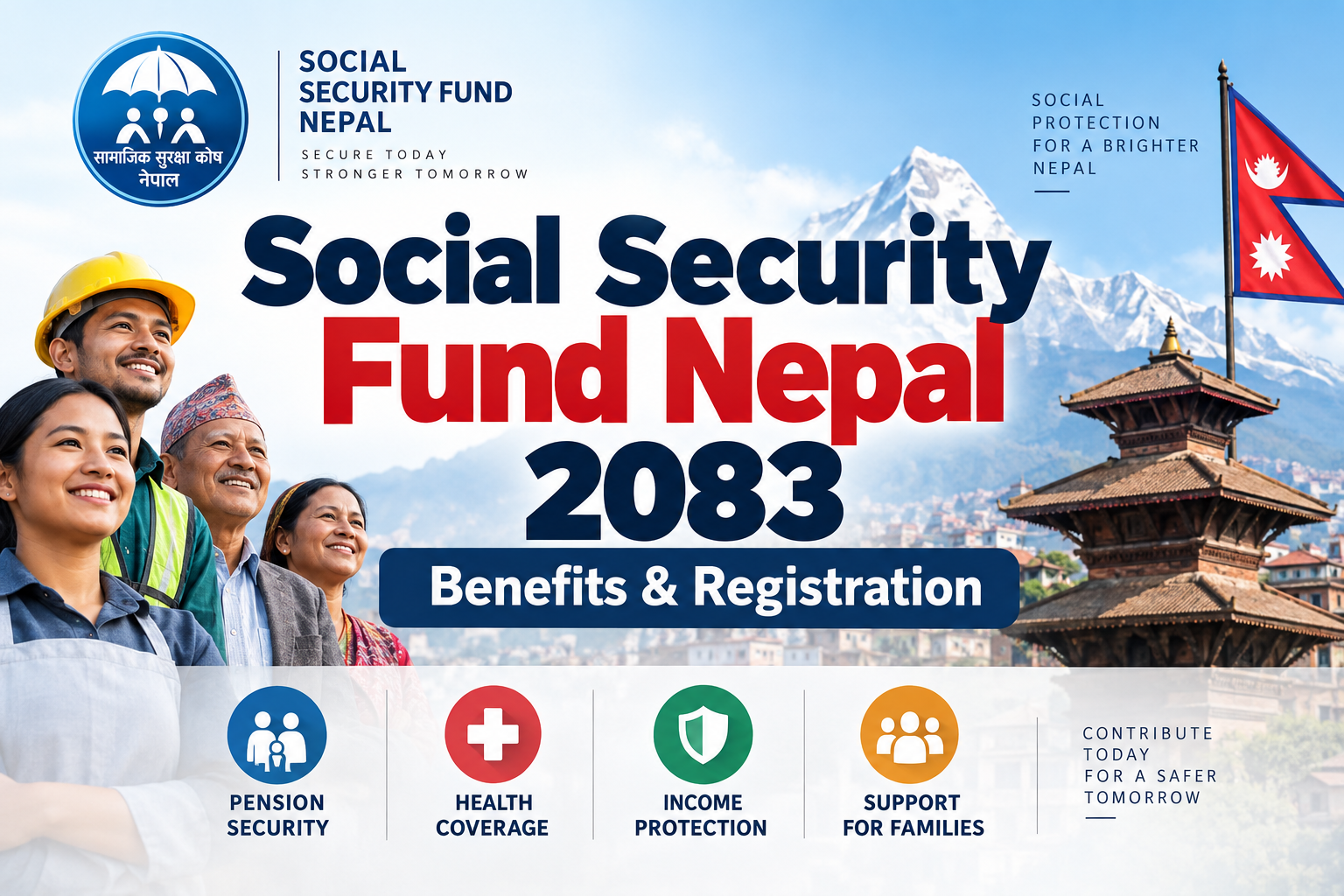
Your payslip shows an SSF deduction, but what do you actually get for it? Many Nepali workers can’t answer that question. That’s a pity, because the Social Security Fund Nepal pays for much more than retirement. It can cover medical bills, accidents, maternity care, and your family’s support if you die.
This guide explains how SSF works in 2083 BS in plain words: who must join, how much you pay, what you can claim, and how to register. Rates and rules change, so use this guide as a map and confirm final details with SSF.
Image suggestion: A smiling employee reviewing a payslip with an SSF line.
Alt text: “Nepali employee checking SSF deduction on monthly payslip”
What Is the Social Security Fund in Nepal?
The Social Security Fund (SSF) is a government body under the Ministry of Labour, Employment and Social Security. It runs a contribution-based system under the Contribution-Based Social Security Act, 2074 BS, and its regulations. Employers and employees pay a fixed share of basic salary each month. In return, workers get several protections in one package.
The fund began as an alternative to older arrangements like provident fund and gratuity. Under the Labour Act, employers must register their company and staff with SSF and deposit provident fund and gratuity amounts there.
Who Must Join SSF? (SSF Eligibility)
In general:
- Private-sector employees working for registered employers must be enrolled.
- Employers (companies, firms, cooperatives and organised entities) must register themselves, then enroll their staff.
- Contractors and similar non-employees may not be registered as regular employees.
- Foreign employees working for a Nepali employer may also be covered, and they may withdraw their retirement fund after employment ends, subject to applicable rules.
Your employer normally completes registration for covered employees. Once enrolled, you receive an SSF identification number. Confirm eligibility, any fee, and the process for carrying your record to a new employer through the official portal.
SSF Contribution Rate: How Much Do You Pay?
The commonly cited total contribution is 31 percent of your basic salary each month. Allowances and bonuses may be treated differently under applicable rules; confirm the basis with SSF or your payroll team.
| Who pays | Share of basic salary |
|---|---|
| Employee | 11% |
| Employer | 20% |
| Total | 31% |
Example With Real Numbers
Say your basic salary is Rs. 40,000:
- Your 11%: Rs. 4,400
- Employer’s 20%: Rs. 8,000
- Total into your SSF account: Rs. 12,400 per month
One breakdown shows the employee’s 11% as 10 percent provident fund plus 1 percent social security tax. The employer’s 20% is shown as 10 percent provident fund, 8.33 percent gratuity, and 1.67 percent additional. Your payslip may present it differently, so ask HR how your payroll is calculated.
Where Does the 31% Go?
Most of the money builds your old-age protection, while a smaller part funds shared protection schemes.
The exact scheme-wise allocation is set by SSF rules and may change through amendments. Published sources show conflicting breakdowns, so this guide does not reproduce percentages that could be out of date. Employers and employees should use the current SSF directive for payroll or policy decisions.
SSF Benefits: What Do You Actually Get?
1. Medical, Health and Maternity Protection
This may cover consultation, hospital stays, surgery, medicines, and maternity care under the applicable scheme. Key points:
- Cost-sharing, annual limits, eligible family members, and covered services depend on the current scheme rules and hospital arrangement. Confirm these details with SSF and the hospital before planned treatment.
- Cashless treatment may be possible at hospitals shown on SSF’s current official list. Ask SSF whether reimbursement is available for other providers.
See our guide to the SSF hospital list in Kathmandu Valley for a starting point. Confirm a hospital’s current status and your eligibility before treatment.
2. Accident and Disability Protection
This helps with injuries and disability. Work-related accidents may be covered for treatment costs, and temporary disability can bring sickness pay. For some non-work accidents, a ceiling applies. Some exclusions exist, such as certain road accidents or cases covered by other insurance, so read the current rules.
3. Dependent Family Protection
If a contributor dies, the family may receive support such as a pension, an education grant, and funeral expenses, subject to the scheme’s conditions.
4. Old-Age Protection
This is the biggest part. It combines a pension plan and a retirement benefit plan. In general:
- Pension eligibility is linked to the applicable retirement age and contribution history.
- The options available when a contributor reaches retirement age depend on the current law and SSF scheme rules; confirm the applicable conditions directly with SSF.
- Withdrawals before 60 are generally not allowed, except in limited cases.
How Long Before You Can Claim? (Waiting Periods)
Eligibility and waiting periods vary by scheme and contributor category. The commonly repeated waiting-period figures in secondary sources conflict, so this guide does not present them as current SSF rules. Check your contributor account and the relevant official scheme directive before planning a claim.
SSF Registration: Step by Step
Registration is online through the SSF SOSYS portal at sosys.ssf.gov.np.
For Employers
- Go to the SSF website or SOSYS portal.
- Choose Employer Registration and create an account.
- Upload your company documents. These usually include the company registration certificate, PAN or VAT certificate, business details, and an authorised representative’s information.
- Submit the employer record for SSF verification. SOSYS says the employer receives portal credentials and an SSID after verification.
- Use the Employer Portal to register contributors and complete their verification.
- Deposit contributions through the employer portal according to the current filing instructions and deadlines shown by SSF.
For Employees
Your employer normally registers you. Required details typically include:
- Citizenship certificate or other ID
- Passport-size photo
- Mobile number
- Bank account details
- PAN, if you have one
Once enrolled and verified, you receive an SSID and login details. The official portal explains the employer and contributor registration flow; use it to confirm current requirements.
Image suggestion: A simple numbered flowchart of the employer and employee registration steps.
Alt text: “SSF registration steps for employers and employees in Nepal”
How to Claim SSF Benefits
- Check your eligibility in the SSF contributor portal or app.
- Choose an SSF hospital if you want cashless treatment.
- Show your SSF ID at registration.
- Ask what co-payment applies and keep every bill.
- If you paid out of pocket, log in to the contributor portal, choose the claim type (medical or maternity), and upload documents.
- Track your claim until SSF decides.
Submitting a claim before you meet the minimum contribution period, or using outdated forms, are common reasons for rejection. Check the latest document requirements before submitting.
SSF vs Provident Fund vs CIT
| Feature | SSF | Old EPF/PF | CIT |
|---|---|---|---|
| Total contribution | 31% (11% + 20%) | About 20% (10% + 10%) | You decide |
| Medical cover | Yes | No | No |
| Accident cover | Yes | No | No |
| Family protection | Yes | No | No |
| Pension | Yes | Lump sum only | Lump sum savings |
SSF has a higher stated contribution rate, but bundles protections that other savings schemes may not offer. Individual circumstances and applicable laws differ, so confirm your options with HR or a qualified adviser.
Common Problems and How to Fix Them
| Problem | Quick fix |
|---|---|
| Salary was cut, but SSF shows missing months | Show payslips to HR and ask for proof of deposit. If the issue continues, contact SSF. |
| Hospital rejects your card | Confirm the hospital’s SSF status and your eligibility first. |
| Dependents are not accepted | Update dependent details in your profile. |
| Claim rejected | Read the reason, fix missing documents, and apply again if allowed. |
| Employer has not registered you | Raise it in writing and report to SSF if needed. |
Tips for Employees and Employers
For employees
- Check your SSF account every few months.
- Save payslips and deposit proofs.
- Add your dependents early.
- Keep your SSF ID safe when you change jobs.
For employers
- Register early and enroll staff on time.
- Deposit contributions by the deadline.
- Keep payroll and SSF records matched.
- Remember that non-compliance can bring fines and legal action.
Frequently Asked Questions
What is the SSF contribution rate in Nepal?
The commonly cited rate is 31 percent of basic salary: 11 percent from the employee and 20 percent from the employer. Confirm current requirements with SSF.
Is SSF mandatory?
For most private-sector employers and their employees, yes. Employers must register and enroll staff, subject to applicable rules.
Does SSF replace provident fund and gratuity?
Under the Labour Act, enterprises must register with SSF and deposit provident fund and gratuity amounts there. Some existing retirement arrangements had special transition rules, so ask HR.
Is there a fee to register for SSF?
No registration fee is reported for employers or employees. Confirm the current process on the official portal.
When can I use SSF medical benefits?
Some sources cite around three months of contribution, but check your own record and current rules on the portal.
Can I take my SSF money out before 60?
Generally, old-age benefits are linked to age 60, with limited exceptions. Confirm your situation directly with SSF.
Does my SSF follow me if I change jobs?
Your SSF ID stays with you, so your contribution history and eligibility can carry over. Verify your record and new employer enrollment in the portal.
Where can I get help?
Use ssf.gov.np, the SSF app, your HR team, or the SSF office. SSF currently lists toll-free number 1116 and call-center number 01-5970016; confirm contact details on the official website.
Conclusion
The Social Security Fund Nepal is more than a salary deduction. It builds your retirement account and protects you and your family against illness, accidents, and loss of income. Know your contribution, check your SSF account regularly, and understand your waiting periods before you need a claim.
Log in to the SSF portal this week and check that every month’s contribution is there. If something looks wrong, talk to your HR team today. Share this guide with a coworker to help them understand SSF rules and benefits.
Sources and Further Reading
- Wikipedia: Social Security Fund Nepal
- Digital Solution Nepal: SSF contribution breakdown
- Nepal HRM: SSF schemes and benefits
- Hajir HR: SSF calculation
- Law Alpine: SSF in Nepal
- Law Bhandari: SSF enrollment process
- Prime Law Nepal: SSF rules
- Pioneer Law: Social security system in Nepal
- Pioneer Law: SSF directive amendments
- KumariJob: How to claim SSF benefits
- Pradhan Law: SSF listing notice
- Lockton: Nepal’s social security contribution
- Social Security Fund Nepal (official)
- SSF SOSYS portal
- SSF hospitals and official contact information
- Ministry of Labour, Employment and Social Security
Frequently asked questions
What is the SSF contribution rate in Nepal?
The commonly cited rate is 31 percent of basic salary: 11 percent from the employee and 20 percent from the employer. Confirm the current applicable rate with SSF.
Is SSF mandatory?
For most private-sector employers and their employees, enrollment is required. Employers should confirm current obligations and deadlines with SSF.
Does SSF replace provident fund and gratuity?
Under the Labour Act, enterprises must register with SSF and deposit provident fund and gratuity amounts there. Some existing retirement arrangements had special transition rules, so ask HR or SSF.
Is there a fee to register for SSF?
Check the current SOSYS instructions and SSF notices for any applicable fee. Do not rely on an old article if the portal or rules have changed.
When can I use SSF medical benefits?
Some sources cite a contribution waiting period of around three months, but eligibility depends on current rules and your record. Check your account or contact SSF.
Can I take my SSF money out before 60?
Generally, old-age benefits are tied to the applicable eligibility conditions, with limited exceptions. Confirm your situation directly with SSF.
Does my SSF follow me if I change jobs?
Your SSF identification number remains associated with you. Confirm your contribution history and new employer enrollment in the contributor portal.
Where can I get help with SSF?
Use ssf.gov.np, the official SSF app, your HR team, or the SSF office. Verify any helpline number on the official website.
Try the free tools
Put this guide to work — every Solutions Nepal tool is free and needs no signup.