
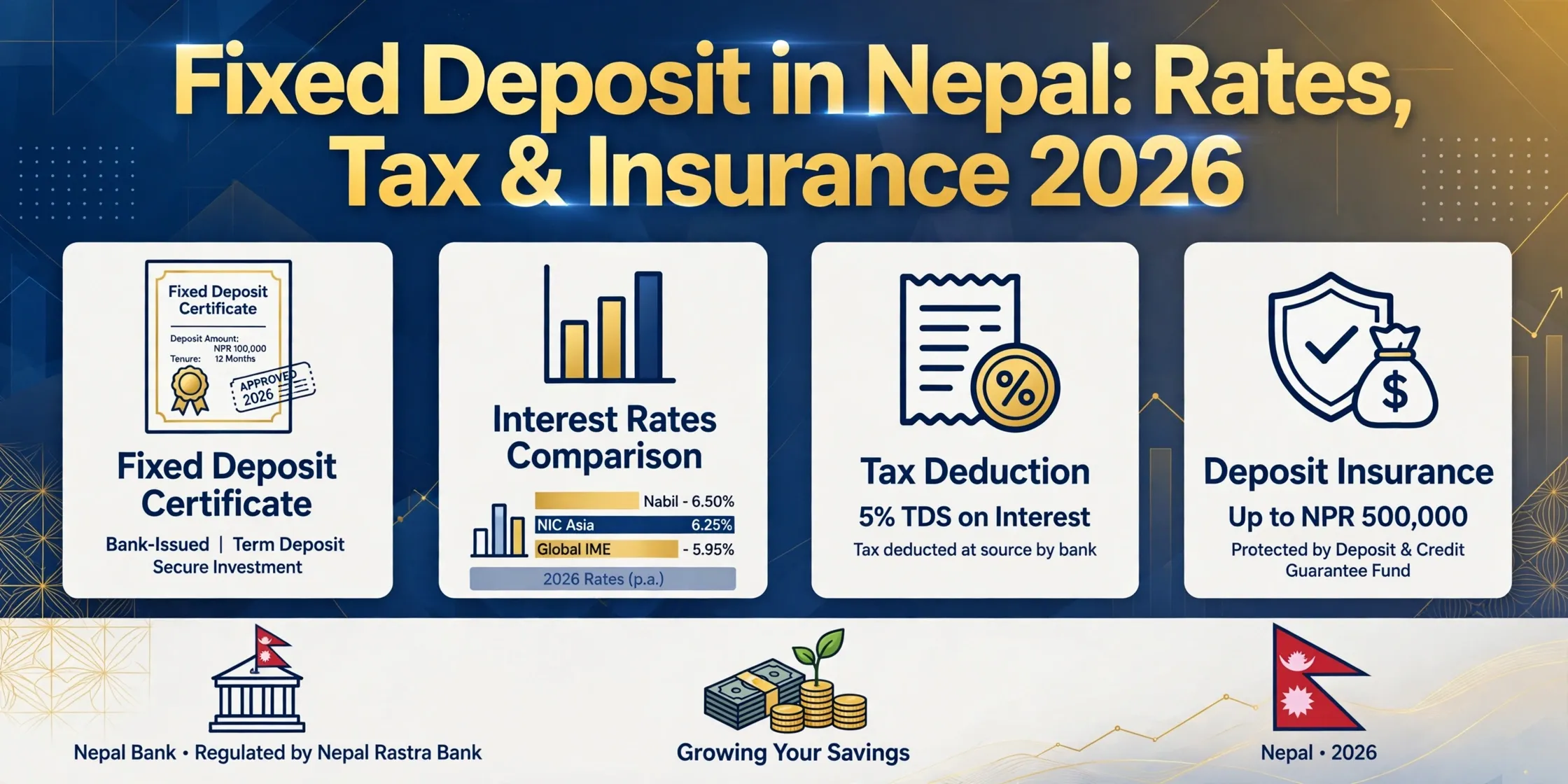
Quick Answer: Fixed Deposits in Nepal
A fixed deposit (FD) places money with a bank or financial institution for an agreed term at a stated interest rate and payout arrangement. The rate depends on tenure, depositor type, product, and the institution's current schedule. It can change, so compare written terms rather than relying on an old advertisement or a general “best rate” list.
Before depositing, check the effective interest rate, maturity amount, tax withholding, early-withdrawal rules, renewal instruction, minimum amount, and deposit-protection eligibility. Keep an emergency fund accessible; an FD may not be freely withdrawable without conditions.
What Is a Fixed Deposit?
An FD is a bank deposit made for a fixed period, such as a few months or several years. Depending on the product, interest may be paid monthly, quarterly, annually, or at maturity. Some deposits compound interest; others pay it out, so two products with the same quoted annual rate may not produce the same cash flow or maturity value.
Banks may publish separate rates for individuals, institutions, remittance deposits, senior citizens, or other eligible groups. Special rates and product names do not automatically apply to every customer. Confirm eligibility and required documents directly with the institution.
Fixed-Deposit Rates and Nepal Bank Example
Interest schedules are updated from time to time. As one bank-specific example, Nepal Bank's published deposit interest-rate schedule currently lists these categories:
| Nepal Bank deposit category | Minimum shown on the schedule | Published annual rate |
|---|---|---|
| Individual FD, 3 months to 1 year | NPR 25,000 | 2.76% |
| Individual FD, over 1 year up to 2 years | NPR 25,000 | 3.00% |
| Individual FD, over 2 years up to 5 years | NPR 25,000 | 3.30% |
| Individual FD, over 5 years up to 10 years | NPR 25,000 | 3.75% |
| Remittance FD, 3 months to 1 year | NPR 5,000 | 3.76% |
| Remittance FD, over 2 years up to 5 years | NPR 5,000 | 4.30% |
| Remittance FD, over 5 years up to 10 years | NPR 5,000 | 4.75% |
These are examples from Nepal Bank's schedule, not rates for all banks or a market-wide “best rate.” The schedule may change without this article changing. Check the linked schedule and ask the bank to confirm the rate that will apply on the day your deposit is booked. The schedule lists additional institutional and remittance terms; check those directly if they apply to you.
How to Estimate Your FD Return
For a simple, non-compounding one-year illustration:
Gross interest = principal × annual interest rate × time
For example, NPR 100,000 at 4% per year for one year gives NPR 4,000 gross interest before applicable withholding or other adjustments. If the bank compounds interest or pays it out at intervals, the actual amount will differ. A quoted annual rate is not always the same as the effective yield you receive.
Ask the bank for a written maturity or payout estimate that shows:
- The principal and exact deposit term.
- The annual rate and whether it is fixed for the full term.
- The interest calculation and compounding frequency, if any.
- Each payout date and whether interest is paid out or reinvested.
- Any withholding or other deductions that affect the amount credited.
- The amount payable at maturity under the selected option.
How to Compare Fixed Deposits
Compare products for the same depositor type, amount, and tenure. A higher headline rate may require a longer lock-in, remittance eligibility, a particular payout method, or other conditions.
| What to compare | What to confirm |
|---|---|
| Institution | Verify it is licensed by Nepal Rastra Bank and use its official channel |
| Rate and effective date | Ask when the quoted rate applies and whether it is fixed after booking |
| Tenure | Check the exact start date, maturity date, and minimum term |
| Payout method | Compare monthly, periodic, and maturity payout terms |
| Early withdrawal | Ask if permitted, how interest is recalculated, and whether a charge applies |
| Renewal | Check whether renewal is automatic and which rate would apply |
| Tax withholding | Ask what the bank will deduct for your depositor category |
| Deposit protection | Check whether the account and depositor are within DCGF rules and limits |
Do not treat a promotional rate as an offer until the bank confirms the terms in writing. If you are considering a loan against an FD, also ask about the loan rate, fees, lien, and what happens if repayments are missed.
How to Open a Fixed Deposit
- Choose a licensed institution. Verify its official website or branch and review its current deposit-rate schedule.
- Select the product and term. Confirm the minimum deposit, eligibility, payout option, rate, and maturity date.
- Prepare the required details. The bank may ask for an existing account, identity and KYC information, and source-of-funds details. Requirements differ by bank and customer.
- For a remittance FD, check eligibility first. Ask what remittance receipts and account records are accepted before transferring funds.
- Read the deposit instruction. Confirm whether interest is paid periodically or at maturity, and whether principal or interest will auto-renew.
- Keep the confirmation. Save the FD receipt or digital confirmation, deposit number, rate, maturity date, and the bank's support contact.
Online opening is available only where the bank supports it for your account and product. Access the service through the bank's official site or app; do not use links sent by an unknown person or share an OTP or transaction PIN.
Maturity, Renewal and Early Withdrawal
At maturity, the bank follows the instruction you selected when booking the deposit. Depending on the product, principal and interest may be credited to a linked account, or the deposit may renew automatically. Renewal terms and rates can differ from the original deposit.
Set a reminder before the maturity date. If you do not want auto-renewal, ask the bank how and when to change the instruction. Check whether a renewed deposit uses the rate available on the renewal date.
Premature withdrawal may be unavailable or may reduce interest, require notice, or incur a charge. These terms vary by institution and product. Do not assume you will receive the advertised rate if you close the FD early; get a written example of the amount payable before opening.
Tax on Fixed-Deposit Interest
Interest may be subject to tax withholding under the prevailing Income Tax Act, annual Finance Act, and applicable rules. The applicable treatment can depend on the depositor's legal status, tax residency, account ownership, and current law. Do not assume one withholding rate applies to every individual, company, or non-resident.
Ask the bank which rate it will withhold for your circumstances and request the relevant tax certificate or statement. For current rules, consult the Inland Revenue Department or a qualified tax professional. This guide is general information, not individual tax advice.
Deposit Protection in Nepal
The Deposit and Credit Guarantee Fund (DCGF) states that eligible deposits of natural-person depositors are protected up to NPR 500,000 at member institutions, subject to the fund's rules. The stated member categories include NRB-licensed commercial banks, development banks, finance companies, and microfinance institutions.
This limit should not be read as unlimited protection or as a guarantee for every type of depositor, account, product, or institution. Check the current DCGF rules, the institution's membership, how the limit is applied across your accounts, and any exclusions before relying on coverage. A deposit above the applicable limit may not be covered in full.
FD Safety Checklist
- Compare current official schedules for the same tenure and customer category.
- Confirm the effective rate, payout method, maturity amount, and all conditions in writing.
- Keep accessible savings for near-term needs rather than locking away every reserve.
- Understand early-closure and automatic-renewal rules before booking.
- Confirm the bank's tax withholding for your situation.
- Verify deposit-protection coverage and do not treat it as covering every balance.
- Deposit only through a licensed institution's official branch, website, or app.
- Never share your OTP, password, or transaction PIN with an agent or caller.
- Keep the FD receipt and note its maturity date.
If you are comparing an FD with a loan or another use for savings, review the costs and risks of both options. See our guide to digital loans in Nepal before borrowing.
Official Sources and Final Note
- Nepal Bank fixed-account information
- Nepal Bank deposit interest-rate schedule
- Deposit and Credit Guarantee Fund
- Nepal Rastra Bank
- Inland Revenue Department
Rates, tax rules, deposit-protection limits, and product conditions can change. Confirm the current official terms with the bank and relevant authority before making a financial decision.
Frequently asked questions
What is the minimum amount for a fixed deposit in Nepal?
The minimum varies by bank, product, customer type, and deposit channel. Nepal Bank's published rate schedule lists NPR 25,000 for its standard individual fixed deposit and NPR 5,000 for its remittance fixed deposit; check the bank's current product terms before applying.
Which bank has the highest fixed-deposit rate in Nepal?
Rates change and depend on tenure, depositor type, remittance eligibility, and product conditions. Compare current official bank schedules for the same deposit type and term; a headline rate is not a reliable market-wide ranking.
Can I withdraw a fixed deposit before maturity?
A bank may allow premature withdrawal subject to its product terms, a reduced interest rate, charges, or other conditions. Confirm the exact calculation and notice requirements with the bank before opening.
Is fixed-deposit interest taxable in Nepal?
Interest income may be subject to withholding or other tax treatment under current law. The applicable rate and final liability can depend on the depositor and current tax rules, so confirm with the bank or Inland Revenue Department.
How much interest will I earn on NPR 100,000?
At a simple annual rate of 4%, NPR 100,000 would earn NPR 4,000 gross for one year before withholding, compounding, and product-specific adjustments. Actual returns depend on the bank's rate and payout terms.
Is a fixed deposit guaranteed in Nepal?
The Deposit and Credit Guarantee Fund states that eligible natural-person deposits at member institutions are protected up to NPR 500,000, subject to the fund's rules. This is limited protection, not a guarantee of every balance or every type of depositor.
Are remittance fixed deposits available to everyone?
Remittance deposits are subject to the bank's eligibility and documentation rules. Ask the bank what transfer evidence, account ownership, and source-of-funds documents it accepts.
Can I open a fixed deposit online?
Some banks let eligible customers open or renew fixed deposits through mobile or internet banking, while others require a branch visit. Use only a channel linked from the bank's official website.
Should I choose monthly or maturity interest payout?
Choose based on your cash-flow needs and the bank's written rate and payout terms. Monthly payouts may use a different rate or calculation from interest retained until maturity.
What happens when my fixed deposit matures?
The bank may credit principal and interest to a linked account or renew the deposit if you selected an auto-renewal option. Confirm the maturity instruction and the rate that would apply to any renewal.
Try the free tools
Put this guide to work — every Solutions Nepal tool is free and needs no signup.