
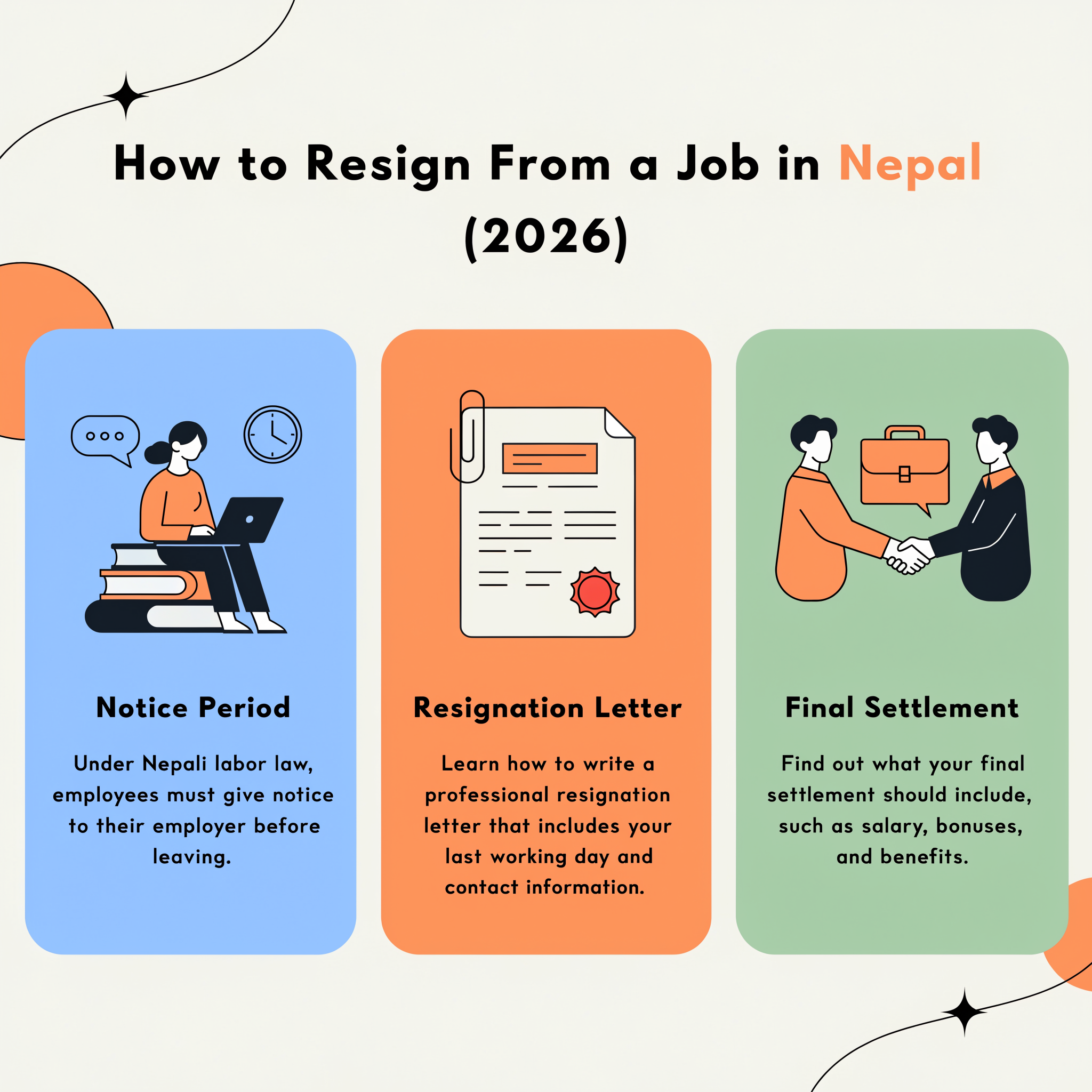
How to Resign From a Job in Nepal: Quick Answer
To resign from a job in Nepal, speak with your manager or HR, submit a dated written resignation, confirm your notice period and last working day, complete a documented handover, and request an itemized final settlement. Before your last day, arrange the return of company property and ask for your employment, fund, and tax records.
The Labour Act 2074 sets notice and employment-end requirements, but the applicable details can depend on the law, your employment category, and your contract. Keep copies of every notice, response, handover record, and payment statement. If there is a dispute about deductions, unpaid wages, or benefits, seek guidance from the relevant labour authority or a qualified adviser.
Notice Period in Nepal
The Labour Act 2074 notice periods are commonly summarized as follows. Confirm the current law and how it applies to your employment before choosing a final working day.
| Length of employment | Commonly cited minimum notice period |
|---|---|
| Up to 4 weeks | 1 day |
| More than 4 weeks and up to 1 year | 7 days |
| More than 1 year | 30 days |
Check your appointment letter, employment contract, workplace rules, and any applicable collective agreement. Do not assume that leaving early automatically permits a particular deduction: ask HR for the legal and contractual basis and a written calculation of any proposed adjustment.
Resignation Letter Format
A clear resignation letter should identify you and your role, state the date you are submitting it, and propose or confirm your last working day. You can keep the reason brief or omit it unless your employer's process requires an explanation.
```text Date: [Date]
To, [Manager/HR Name] [Company Name] [Address]
Subject: Resignation from the post of [Your Position]
Dear [Manager/HR Name],
I am writing to resign from my position as [Your Position] at [Company Name]. My proposed last working day is [Date], after serving the applicable notice period of [Number] days, subject to confirmation.
I will coordinate the handover of my pending work and return company property before my last working day. Please confirm receipt of this letter, my last working day, and the exit-clearance and final-settlement process.
Thank you for the opportunity to work with the company.
Sincerely, [Your Name] [Employee ID] [Contact Number] ```
Submit it through a channel that creates a record, such as an acknowledged letter or email to HR and your manager. Keep a copy and ask for written confirmation of receipt and the agreed last day.
Step-by-Step: Resign From a Job
- Review your documents. Check your appointment letter, employment contract, workplace policies, and applicable notice requirements.
- Speak with your manager or HR. A conversation can help coordinate timing, but follow it with written notice.
- Submit the resignation. Include your position, submission date, and proposed last working day.
- Confirm receipt and timing. Ask HR to confirm the notice period and last day in writing.
- Continue work during the notice period. Agree on priorities and document any approved leave or changes to the notice arrangement.
- Prepare a handover. List ongoing tasks, deadlines, files, access, and the person taking over each responsibility.
- Return company property. Record the return of devices, ID cards, keys, documents, and other assets; retain a receipt where possible.
- Complete clearance. Ask which exit forms, approvals, or no-dues steps are required.
- Request your final settlement. Ask for an itemized calculation and the expected payment date.
- Collect employment and financial records. Save your experience certificate, salary and tax documents, leave calculation, and fund statements.
- Keep a complete file. Retain copies of the resignation, acceptance, handover, clearance, settlement, and payment evidence.
Final Settlement in Nepal
Section 148 of the Labour Act 2074 is commonly cited for an employer's obligation to pay amounts due within 15 days after employment ends. Confirm the current statutory wording and how it applies to your situation. Request a written, itemized settlement rather than relying only on a verbal total.
| Settlement item | What to check |
|---|---|
| Salary through the last working day | Days counted, approved leave, and any unpaid salary |
| Leave encashment | Eligible accumulated leave and calculation basis |
| Bonus or other accrued amount | Eligibility, period, and applicable policy or law |
| Approved deductions | Written basis and calculation for advances, loans, or other deductions |
| Contributions or benefits | Relevant SSF, PF, CIT, or gratuity records; these may be separate from salary settlement |
| Payment record | Amount, payment date, bank entry, and any acknowledgement requested |
Read any settlement or release document before signing. If you disagree with an amount, request a corrected calculation or record your disagreement in writing and get advice before signing a statement that says all dues are fully settled.
Leave Encashment
The Labour Act 2074 is commonly summarized as providing home leave at one day for every 20 days worked, subject to a 90-day accumulation limit, and sick leave of 12 days per year, subject to a 45-day accumulation limit. Eligibility, balances, and settlement calculations should be checked against the current Act, your records, and any applicable workplace rules.
| Leave type | Commonly cited accrual | Commonly cited accumulation limit |
|---|---|---|
| Home leave | 1 day for every 20 days worked | 90 days |
| Sick leave | 12 days per year | 45 days |
Ask HR for your leave ledger and the basis used to calculate any payment on separation. Check how the applicable law defines the calculation base; do not assume gross salary or basic salary without confirming the governing rule and your employment details.
SSF, PF, CIT, and Gratuity Records
Ask for statements and contribution records for any applicable Social Security Fund (SSF), provident fund (PF), Citizen Investment Trust (CIT), or gratuity arrangement. These accounts or benefits may be separate from the final salary settlement.
| Fund or benefit | Records to request |
|---|---|
| SSF | Contribution statement, employer contribution record, and applicable transfer or benefit instructions |
| Provident fund (PF) | Contribution statement and the administrator's withdrawal or transfer procedure |
| CIT | Contribution statement and current account or withdrawal instructions |
| Gratuity | Eligibility and calculation record, where applicable |
Do not withdraw or close an account automatically when changing jobs. Transfer, withdrawal, and benefit rules differ by scheme and may depend on your next employment and contribution history. Confirm directly with Social Security Fund or the relevant fund administrator.
Tax Documents to Collect
Ask your employer for the applicable tax deduction or withholding statement for the period you worked. Section 91(3) of the Labour Act 2074 is commonly cited in relation to issuing a tax deduction certificate when employment ends during the year; confirm the current requirement and document name with your employer or the Inland Revenue Department.
| Document | What to check |
|---|---|
| TDS or withholding statement | Your name/PAN, income period, taxable amounts, and tax deducted |
| Salary slips | Salary components, deductions, and payment periods |
| Bank statement | Salary deposits and any settlement payment |
| Tax-clearance certificate | Whether a separate authority or transaction specifically requires it |
A tax-clearance certificate is not automatically needed for every resignation. If a bank, visa process, tender, or other transaction asks for one, check the exact requirement. See our tax clearance certificate guide.
Employee Exit Documents Checklist
Request and retain copies of documents that apply to your role and employment:
- Resignation letter and proof of submission
- Resignation receipt or acceptance and confirmed last working day
- Handover and company-property return records
- Experience certificate, if requested
- Relieving letter, if the employer issues one or a future employer requests it
- Final settlement statement and payment evidence
- Leave balance and any encashment calculation
- Salary certificate and recent salary slips
- SSF, PF, CIT, and gratuity records, where applicable
- TDS or withholding statement
- No-dues or exit-clearance record, if applicable
The statutory experience certificate and a relieving letter are not necessarily the same document. Ask HR what it can issue and keep your request in writing.
Common Resignation Mistakes to Avoid
- Leaving without dated written notice or proof that it was received.
- Assuming a notice period or last working day without checking the applicable rules and contract.
- Agreeing to an unexplained salary deduction instead of requesting its written basis.
- Failing to document handover or return of company property.
- Signing a final settlement without reading the calculation and release wording.
- Forgetting to request a final salary, leave, fund, and tax record.
- Withdrawing SSF or PF without checking transfer and benefit rules.
- Relying on verbal promises about the experience certificate or settlement date.
- Sharing passwords or retaining confidential company data during handover.
Official Sources and Important Note
For labour-law information, consult the Ministry of Labour, Employment and Social Security and confirm the current Labour Act 2074 and applicable regulations. For contributions and benefits, contact the Social Security Fund. For tax records, consult the Inland Revenue Department. If a dispute arises over wages, deductions, leave, notice, or documents, contact the relevant labour office or a qualified employment-law adviser.
Last updated: November 10, 2026. This guide is general information, not legal advice. Notice, settlement, leave, and fund rules can depend on the current law, employment category, contract, and facts of a case. Verify before acting.
Frequently asked questions
How do I resign from a job in Nepal?
Tell your manager or HR, submit a dated written resignation, confirm your notice period and last working day in writing, complete the handover, return company property, and request an itemized final settlement and employment documents.
What is the notice period in Nepal?
The Labour Act 2074 provides minimum notice periods commonly summarized as one day for employment of up to four weeks, seven days for four weeks to one year, and 30 days for more than one year. Check the current law, your employment category, and contract before setting your last day.
When should I get my final settlement?
Section 148 of the Labour Act 2074 is commonly cited for payment of dues within 15 days after employment ends. Ask for an itemized statement and check current law and your circumstances if payment is delayed or disputed.
Can I get an experience letter after resigning?
Section 150 of the Labour Act 2074 is commonly cited as requiring an experience certificate when a worker whose employment has ended requests one. Submit the request in writing and keep a copy.
Do I need a relieving letter in Nepal?
A relieving letter may be an employer or industry practice, but it is distinct from statutory documents such as an experience certificate. Ask HR which exit documents it issues and confirm requirements with your next employer.
Can I withdraw SSF, PF, or CIT after resigning?
Resignation does not automatically mean you should close or withdraw a fund account. Withdrawal, transfer, and benefit eligibility depend on the scheme's current rules and your circumstances; contact SSF, your PF administrator, or CIT directly.
What documents should I collect before leaving a job?
Keep your resignation and acceptance, final settlement statement, experience certificate, salary and tax records, leave calculation, no-dues or clearance record, and SSF/PF/CIT contribution statements where applicable.
Do I need a tax-clearance certificate after leaving a job?
Not necessarily. Ask your employer for the applicable tax deduction or withholding statement. A tax-clearance certificate may be requested for a separate transaction, but it is not automatically required for every resignation.