
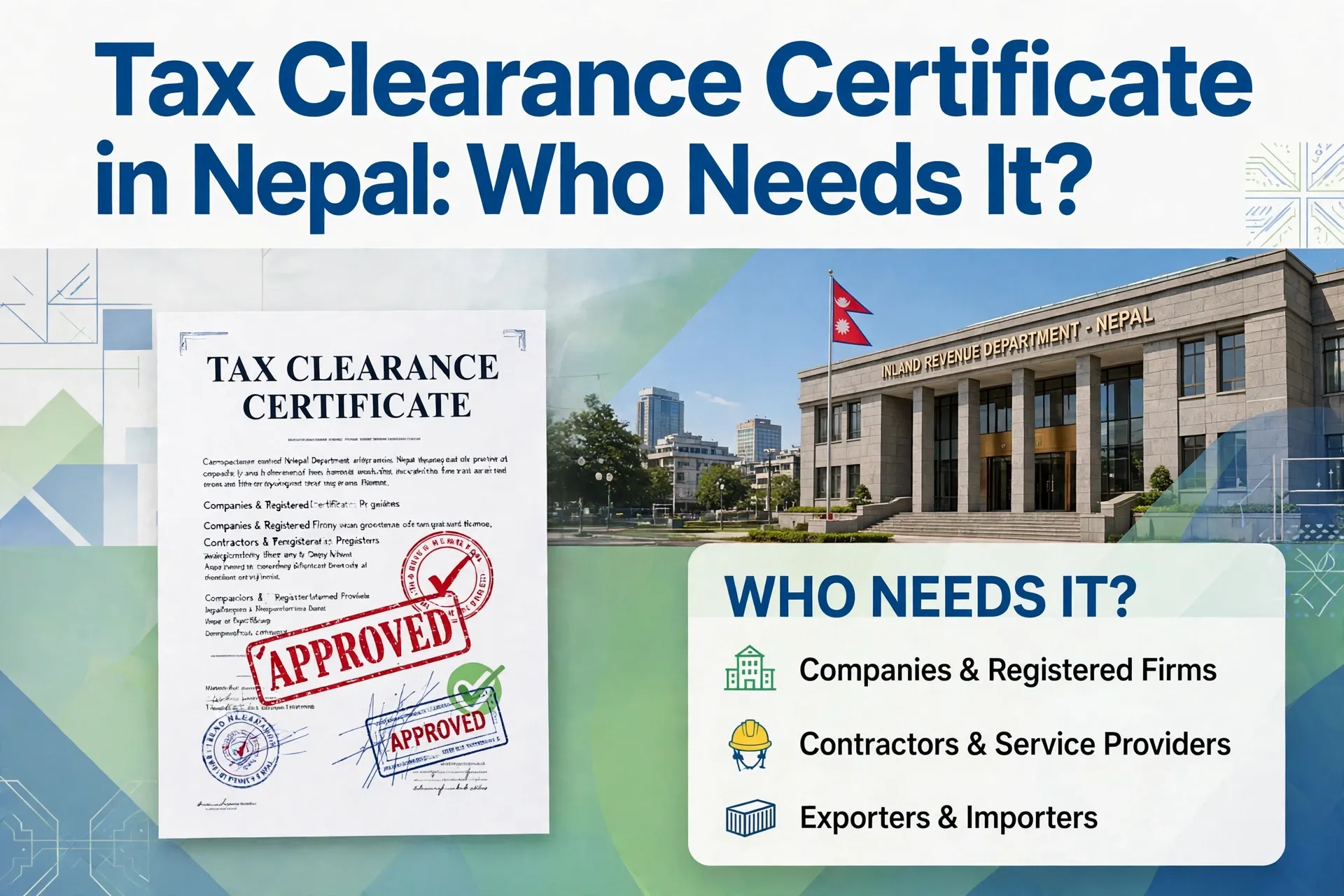
A tax clearance certificate in Nepal, also called *kar chukta pramanpatra*, is an Inland Revenue Department (IRD) document showing a taxpayer's clearance status for a specified period. A government office, bank, tender authority, or other organization may request one for a particular transaction or filing.
You do not necessarily need a new certificate every year. First confirm which taxpayer, fiscal year, and purpose the requesting authority requires. Individual and business applications can follow different processes, and not every taxpayer can download a certificate directly from the portal.
Who Needs a Tax Clearance Certificate?
The organization handling a transaction decides whether it needs tax-clearance evidence and which period it must cover. A certificate may be requested for situations such as:
| Situation | Who may be asked for it |
|---|---|
| Government tender or procurement | Companies, contractors, or bidders, where the tender rules require it. |
| Buying or selling property | A buyer or seller when the Land Revenue Office or transaction process requires tax documents. |
| Bank loan or credit application | An individual or business when the lender requests evidence of tax compliance. |
| Visa or foreign-employment process | Applicants or employers when the relevant authority asks for it. |
| Licence renewal | A company, firm, or professional renewing a licence where clearance is required. |
| Company closure or PAN cancellation | A company or its authorized representative settling obligations before closure. |
| Company annual compliance | A company completing a filing that requires current tax records. |
These are examples, not a rule that every person in each situation must obtain a certificate. Check the current instructions from the office or organization requesting it.
What the Certificate Confirms
Depending on the taxpayer and fiscal period, IRD may review whether required tax filings and payments are up to date. This can include:
- Required income-tax returns and related tax payments.
- Outstanding tax, interest, and penalties.
- VAT returns for a VAT-registered taxpayer.
- TDS or e-TDS filings and payments, where applicable.
- Pending assessments or other issues that affect the requested clearance.
A certificate records clearance status for the period stated on it. It does not prove a particular income level or guarantee approval of a visa, loan, tender, property transfer, or licence.
Documents You May Need
Requirements vary by taxpayer type, fiscal year, and application route. Gather the documents that apply to your case and confirm the exact checklist with your IRD office or the Taxpayer Portal.
| Document or record | Individual | Company or firm |
|---|---|---|
| PAN certificate or PAN number | Usually needed | Usually needed |
| Income-tax return for the relevant fiscal year | As applicable | Annual return, often D-03 for a company |
| Tax-payment receipts or vouchers | If tax is due or paid | If tax is due or paid |
| VAT returns | If VAT-registered | If VAT-registered |
| TDS or e-TDS records | If applicable | If applicable |
| Citizenship or passport | May be requested for identity checks | For an authorized representative, if requested |
| Audited financial statements and audit report | May be requested depending on the case | Commonly relevant; confirm the current IRD checklist |
| Rent-tax records | If applicable | If applicable |
| Authorization letter | If someone applies on your behalf | Usually needed for an authorized representative |
| Previous clearance certificate | Sometimes requested | May be requested for renewal or follow-up |
Company cases may involve a D-03 return, audit report, audited financial statements, payment vouchers, VAT filings, and e-TDS records. Check the IRD request for your specific fiscal year rather than treating this list as exhaustive.
For help with PAN setup, see our guide to PAN and VAT registration in Nepal. Companies can also review company registration and compliance steps.
How to Get a Personal Tax Clearance Certificate Online
Some individual taxpayers may be able to use the personal tax-clearance declaration in the IRD Taxpayer Portal. Eligibility can depend on current IRD criteria, your sources of income, income limits, and whether the employer's TDS and e-TDS records are correct in the system.
The supplied process describes a route for some salaried taxpayers with one employer, income below the applicable limit, and no business, rental, or freelance income. Do not assume those conditions are current or sufficient for your case; check the eligibility notice in the portal or ask IRD before relying on the online option.
If the portal confirms that you are eligible:
- Open the official IRD Taxpayer Portal.
- Register or sign in using your PAN and the verification details requested.
- Review your taxpayer information in KYT and correct any errors.
- Open the Tax Clearance section or the equivalent option currently shown.
- Complete the personal tax-clearance declaration with your income and relevant deductions or contributions.
- Review the details, submit the declaration, and download the certificate if IRD approves it.
The portal may use different labels or ask for additional information. If employer TDS or e-TDS records are missing or incorrect, ask the employer to correct them and check the portal again.
How to Get a Company Tax Clearance Certificate
Company clearance is generally checked against the entity's returns, payments, and supporting records. The request may be processed through the Taxpayer Portal or require follow-up with the registered IRD office.
- File the company's income-tax return for the relevant fiscal year.
- Pay outstanding tax, interest, and penalties shown in the taxpayer account.
- File VAT returns and e-TDS statements where applicable.
- Prepare the audit report and audited financial statements requested for the case.
- Gather the PAN, return acknowledgements, payment vouchers, and authorization documents.
- Submit the application through the route IRD specifies.
- Respond to any IRD request for additional information, then download or collect the certificate after approval.
Requirements can differ for a company, firm, or other entity type. Confirm the right return form, fiscal period, audit documents, and submission route with IRD or a qualified tax professional.
How to Apply Through the IRD Portal
The portal options can vary by taxpayer and the type of clearance requested. A general sequence is:
- Open the official IRD Taxpayer Portal and sign in with your PAN credentials.
- Confirm that your PAN and taxpayer details are correct, including KYT information where applicable.
- Check that required tax returns for the relevant fiscal year have been filed.
- Review the account for unpaid tax, interest, penalties, missing VAT or TDS filings, and other notices.
- Open the tax-clearance or certificate-request option available to your account.
- Select the applicable fiscal year and purpose, and provide requested documents.
- Submit the request and follow any review instructions from IRD.
- Download the certificate if the portal makes it available, or collect it through the office process IRD specifies.
If the portal does not show a clearance option or your case needs manual review, contact the IRD office where your taxpayer record is registered. Do not submit a second request until you understand the status of the first one.
How to Check a Tax Clearance Certificate
Use the official IRD certificate-verification service if one is provided for your certificate. Follow its instructions and enter only the certificate details requested, such as PAN, fiscal year, or certificate number. If verification is not available online, ask the issuing IRD office or the organization that requested the certificate how it verifies the document.
Keep a secure digital copy and any original or printed version you receive. Check that the taxpayer name, PAN, fiscal year, and certificate number are correct before submitting it to another authority.
Common Reasons Applications Are Delayed
| Issue | What to check |
|---|---|
| Required income-tax return is missing | File the relevant return and confirm it appears in the taxpayer account. |
| VAT return is missing | File any pending return if you are VAT-registered. |
| TDS or e-TDS records are incomplete | Ask the employer or withholding agent to reconcile or correct the records. |
| Tax, interest, or penalty is unpaid | Review the IRD account and settle amounts due or ask IRD about a disputed amount. |
| PAN or taxpayer details are incorrect | Correct the taxpayer profile through the approved IRD process. |
| Assessment or audit is pending | Contact the responsible IRD office for the required next step. |
| Company audit report is missing | Prepare and submit the financial statements or audit material requested for the fiscal year. |
| Wrong fiscal year or purpose selected | Confirm what the requesting authority requires and submit the correct request. |
If the portal displays a notice or rejection reason, follow that instruction first. For disputed amounts or unresolved assessments, seek guidance from IRD or a qualified tax professional rather than guessing which filing to change.
Cost and Processing Time
Whether a separate certificate fee applies and how long a request takes depend on the current IRD process and the type of application. A straightforward eligible portal request may be completed faster than a company case requiring manual review.
You may still need to pay outstanding tax, interest, or penalties. Accounting, audit, or professional-support fees are separate and depend on the work required. Confirm current fees and status directly with IRD; no processing time is guaranteed.
If you are filing an income-tax return, see our guides to Nepal income-tax slabs and VAT returns for related topics. For company status and filings, use the Office of the Company Registrar as appropriate.
For official requirements and updates, consult the Inland Revenue Department, the IRD Taxpayer Portal, and the Public Procurement Monitoring Office for tender-specific requirements.
Frequently asked questions
What is a tax clearance certificate in Nepal?
It is an Inland Revenue Department document showing tax-clearance status for a specified taxpayer and fiscal year. It does not certify income or guarantee approval for another application.
Who needs a tax clearance certificate in Nepal?
Individuals and businesses may be asked for one for tenders, property transfers, loans, visas, licence renewals, company closure, or other official processes. The requesting authority decides whether it is required.
How do I get a tax clearance certificate online in Nepal?
Sign in to the IRD Taxpayer Portal, review your taxpayer details and filings, then use the available tax-clearance or certificate request option. Some taxpayers may need IRD office review.
Can a salaried person get a tax clearance certificate online?
Some salaried taxpayers may qualify for the portal's personal declaration process. Eligibility depends on current IRD rules, income sources, and correct employer TDS records.
What documents do I need for a company tax clearance certificate?
Depending on the case, IRD may request the company PAN, tax returns, payment records, VAT and e-TDS filings, audit report, audited financial statements, and authorization documents.
Is a tax clearance certificate free in Nepal?
The certificate request may not have a separate issuance fee, but outstanding tax, interest, penalties, audit work, or professional services can involve costs. Confirm current charges with IRD.
How long is a tax clearance certificate valid?
It relates to the taxpayer and fiscal period stated on the certificate. Ask the requesting authority which fiscal year or validity period it requires.
What should I do if my certificate is not generated?
Check for missing returns, unpaid dues, incorrect PAN or taxpayer details, pending TDS records, or an assessment under review. Contact your registered IRD office if the portal does not explain the issue.
Try the free tools
Put this guide to work — every Solutions Nepal tool is free and needs no signup.