
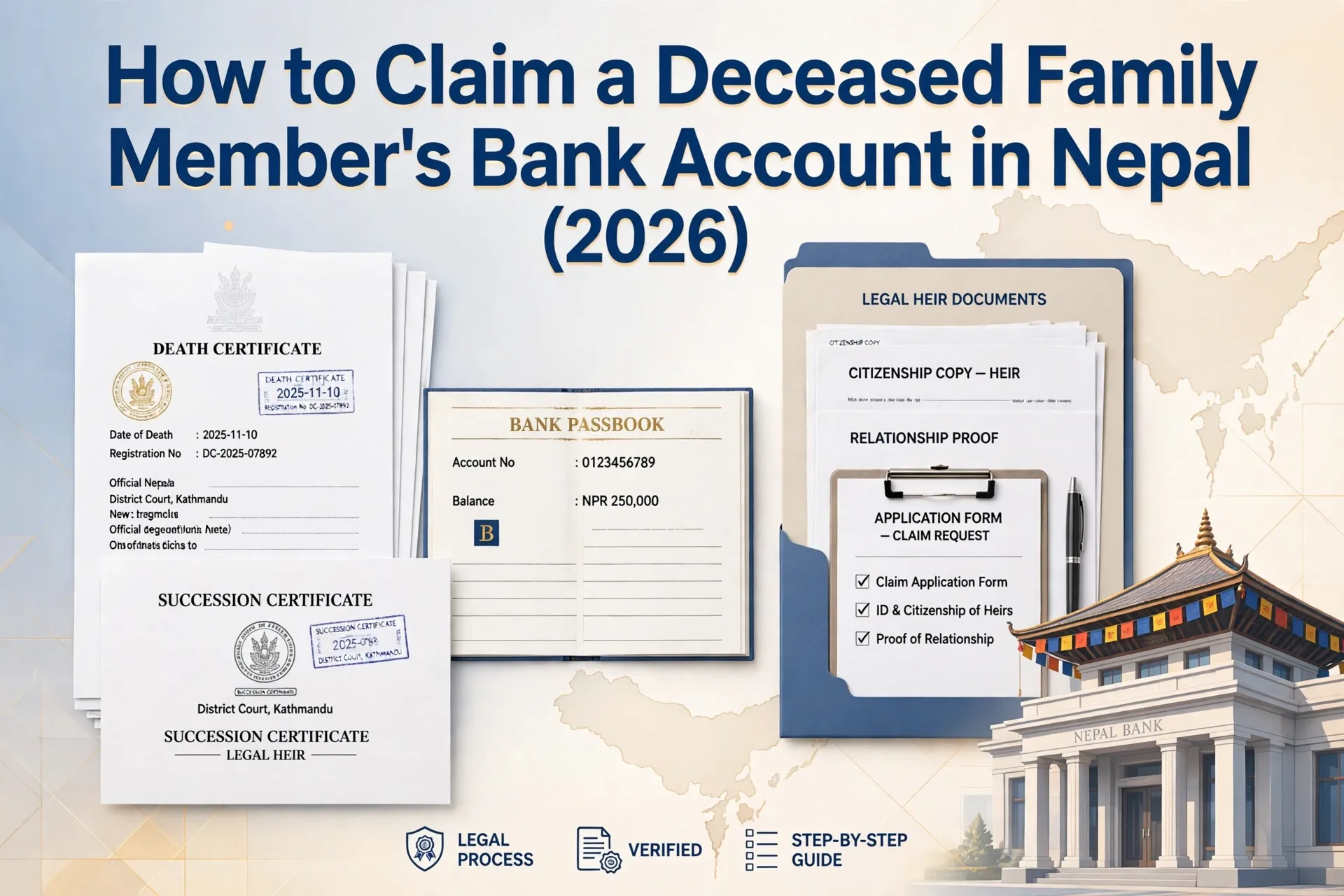
Quick Answer: Claiming a Deceased Person's Bank Deposit
If a family member dies with money in a Nepali bank or financial institution, notify the institution through an official channel and ask for its current written death-claim process. The bank must verify who is legally entitled to claim before releasing funds.
Do not use the deceased person's ATM card, mobile banking, cheque book, or credentials after death. Preserve the account records and let the bank guide you through nominee, heirship, and document verification.
For the civil-registration step, see our guide to registering a death in Nepal.
Who Can Claim the Deposit?
Section 111 of the Bank and Financial Institution Act, 2073 (BAFIA) addresses claims to deposits after a depositor's death. It provides for a nominee appointed by the depositor and, if no nominee exists or the nominee has also died, a priority sequence for specified relatives. The bank must confirm the current legal requirements and the claimant's evidence.
A nominee's role in the bank's release process does not automatically settle every inheritance or distribution question among family members. If several heirs disagree, a nominee has died, the nominee is a minor, or the family structure is complex, obtain the bank's written position and consider legal advice before signing a release or settlement.
BAFIA Section 111 and Relative Priority
BAFIA Section 111(2) lists relatives in an order that includes family members living in a joint family and separately. The Act's sequence begins with:
- Husband or wife living in a joint family
- Son or daughter, adopted son or daughter, or widowed daughter-in-law living in a joint family
- Father, mother, grandson, or granddaughter living in a joint family
- Certain spouses, children, parents, daughters-in-law, or married daughters living separately
- Other relatives in the further order set out in the Act
This is a summary, not a substitute for the complete statutory text. Whether a person fits a category can depend on facts and the current law. Review the full provision and ask the bank how it applies before assuming that a particular relative can collect the deposit.
Documents the Bank May Request
Requirements differ by institution, account type, nominee record, and family circumstances. Ask the bank for a written checklist. It may request:
- Death-registration certificate from the relevant ward or local registrar
- Claimant's citizenship certificate or other accepted identity document
- Deceased account holder's identity details
- Evidence of nominee status or relationship and heirship
- Written application and the bank's claim or transmission forms
- Passbook, cheque book, fixed-deposit receipt, account number, or other deposit details, if available
- Bank statement or other proof of the account relationship
- Birth certificate and guardian documents if a minor is involved
- Court-issued successor or other order if the bank says it is required
- Additional declarations, consents, indemnities, or authorizations requested under the bank's process
These are examples, not a universal document list. Do not pay for a court certificate solely because an informal source says it is always required; first ask the bank which legal document it needs and why.
For a related civil document, see the relationship-certificate guide. If the deceased also had a life-insurance policy, our life-insurance death-claim guide covers that separate process.
Step-by-Step: Contact the Bank and File a Claim
- Register the death. Obtain the death-registration certificate from the appropriate local registrar.
- Collect account clues. Look for passbooks, account statements, fixed-deposit receipts, salary or pension records, remittance receipts, tax papers, and bank messages.
- Contact the bank securely. Use the bank's official branch, phone number, or website. Explain that the account holder has died and ask how to notify the bank and identify the correct claim unit.
- Ask about nomination and requirements. Provide only the information the bank requests for initial verification. Ask for a dated written checklist and whether it requires a relationship certificate, court document, or heir consent.
- Notify and protect the account. Follow the bank's instructions for recording the death and securing or restricting account access while the claim is reviewed.
- Coordinate among family members. If there are multiple relatives who may be entitled, discuss the process and obtain legal advice if there is disagreement.
- Submit the claim. Give the completed forms and required evidence through the bank's approved channel. Obtain an acknowledgement listing what the bank received.
- Respond to requests and confirm payment. Keep copies of every submission and ask the bank to explain any missing document or proposed distribution in writing.
The bank may limit what it can disclose about an account until a claimant establishes identity and authority. Do not try to access the deceased person's digital banking to discover balances.
What If There Is No Nominee?
If no nominee was appointed, or the named nominee has died, BAFIA's relative-priority provision may apply. The bank may need evidence to establish the family relationship, whether relatives fall within the statutory categories, and whether there is a competing claim.
A ward-issued relationship document may support the application, but do not assume it will replace every other requirement. If the bank requests a successor certificate or court order, ask for the request and its basis in writing. Court process, notices, and evidence are case-specific; consult the relevant District Court or a qualified legal professional for procedural advice.
Dormant Accounts, Mergers, and Closed Banks
- Dormant or inactive account: Ask the bank what identity verification, account reactivation, and deceased-customer transmission forms are required. Follow the bank's security process.
- Merged institution: Contact the licensed successor bank or financial institution and provide the old account name, branch, passbook, or deposit details. Request confirmation that it is the authorized successor handling the record.
- Closed, liquidated, or licence-cancelled institution: Contact Nepal Rastra Bank through its official channels to ask which current process applies. Do not send original documents or pay a third party without verifying authority.
- Possible unclaimed deposit: BAFIA Section 111 contains a provision about the Banking Development Fund where no person in the stated priority or successor exists. Ask the institution or NRB how the current law applies to the specific deposit.
Common Problems and What to Do
| Problem | Practical next step |
|---|---|
| Death certificate is missing | Register the death with the appropriate local registrar first. |
| Account details are unknown | Review family records and ask likely banks about their verified process for a deceased customer. |
| Nominee details are unclear | Ask the bank to explain what it can disclose and what proof it needs. |
| More than one heir disputes the claim | Pause distribution, request the bank's written requirements, and seek legal advice. |
| Bank requests a court order | Ask which order or certificate it requires and why before starting a court process. |
| Account is dormant | Ask for the bank's reactivation and transmission requirements. |
| Bank has merged | Contact the licensed successor institution. |
| Institution was liquidated or licence cancelled | Ask Nepal Rastra Bank which claim channel currently applies. |
Protect the Deceased Person's Account
- Do not use the deceased person's card, cheque book, mobile banking, PIN, password, or OTP.
- Notify the bank and follow its instructions for securing access.
- Use only verified bank or Nepal Rastra Bank contact details.
- Do not pay a broker who promises to release the money or bypass bank procedures.
- Keep copies and dated acknowledgements for every document submitted.
- Do not sign blank forms or consent to a distribution you do not understand.
- Get legal advice when there is a dispute, unclear entitlement, or a substantial balance.
Claimant Checklist
- Obtain the death-registration certificate.
- Collect available account, passbook, and fixed-deposit information.
- Notify the bank through an official channel.
- Request written confirmation of nominee information where the bank can disclose it.
- Get the bank's case-specific document checklist before paying court or certification fees.
- Gather identity, relationship, heirship, and any court documents requested.
- Coordinate with other potentially entitled relatives and resolve disputes appropriately.
- Keep receipts, copies, correspondence, and the bank's claim acknowledgement.
Official Sources and Final Note
The governing provision is Section 111 of the Bank and Financial Institution Act, 2073. The linked Section 111 text is a legal-text reference; confirm the current authoritative Act and amendments through Nepal Rastra Bank or a qualified legal professional. For case-specific documents and account handling, contact the institution holding the deposit.
Last updated: November 7, 2026. The bank must assess each claim against the current law, records, and family circumstances. This guide is general information, not legal advice or a guarantee of payment.
Frequently asked questions
Who can claim a deceased person's bank deposit in Nepal?
BAFIA Section 111 addresses a nominee and, if there is no nominee or the nominee has died, identifies a statutory order of relatives. The bank must verify the claimant and apply the current law to the facts. Contact the bank for its written process.
What documents are needed to claim a deceased person's bank account?
A bank may request the death-registration certificate, claimant identity, relationship or heirship evidence, a written application, account or deposit details, nominee information, and its own forms. Court documents or additional evidence may be required depending on the case.
Does a nominee automatically own all the money?
A nominee is relevant to the bank's release process under BAFIA. Questions about ultimate entitlement or distribution among heirs can depend on inheritance law and the circumstances; seek legal advice if there is a dispute.
Is a court order always required to claim an account?
Not necessarily. The bank decides what evidence is sufficient under applicable law and its procedures. Ask for a written document checklist before applying to court or paying fees.
How can I find a deceased person's bank account?
Review available passbooks, statements, tax and salary records, remittance receipts, fixed-deposit papers, and bank messages. Contact likely banks through their official channels with proof of death and your identity; banks may restrict what they can disclose before verifying authority.
What happens to an unclaimed bank deposit?
BAFIA Section 111 includes a provision for deposits where no person in the stated priority or successor exists, referring to the Banking Development Fund of Nepal Rastra Bank. Ask the bank or NRB how the current law applies; do not assume an ordinary unclaimed-account procedure transfers a relative's deposit immediately.
Can heirs claim a dormant account?
Ask the bank whether the account is dormant and what identity, heirship, reactivation, and transmission steps apply. Dormancy alone should not be treated as proof that the funds have been transferred or forfeited.
What if the bank has merged or closed?
If it merged, contact the licensed successor institution and provide old account or deposit records. If it was liquidated or its licence was cancelled, ask Nepal Rastra Bank for the current process.
Try the free tools
Put this guide to work — every Solutions Nepal tool is free and needs no signup.