
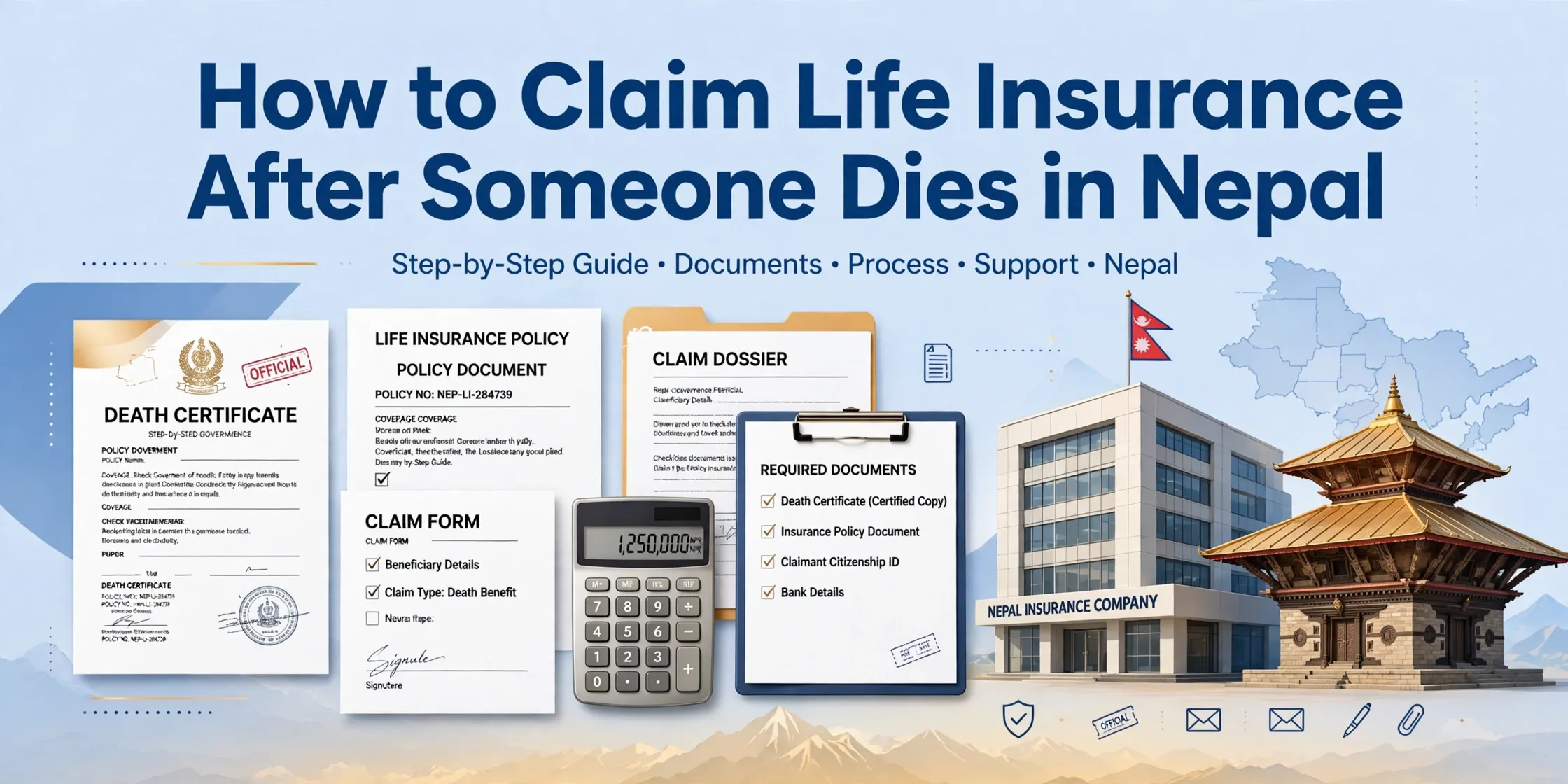
How to Claim Life Insurance After a Death in Nepal
To claim a life-insurance policy after someone dies in Nepal, contact the insurer as soon as practical, ask for its current written death-claim checklist, and submit the required forms and evidence. You do not need to wait until every document is collected before notifying the company.
The person named in the policy as nominee can usually start the claim process. The right to receive the proceeds, and what happens if the nominee is unavailable or a minor, depends on the policy and applicable law. Ask the insurer to explain any additional legal-heir or guardian documents it needs.
For the death-registration process, see our guide to registering a death in Nepal.
Who Can Submit the Claim?
The policy's nominee is generally the first person to contact the insurer and lodge a claim. A nominee designation does not by itself answer every question about beneficial entitlement or succession; the policy terms and applicable law govern payment.
| Situation | What to ask the insurer |
|---|---|
| A living nominee is named | How to verify the nominee and submit the claim |
| No nominee is recorded | Which legal-heir and succession documents are required |
| The nominee died before the insured | How the insurer will establish the eligible claimant |
| A nominee is a minor | Which guardian, identity, and account documents are needed |
| Someone acts for the claimant | Whether a power of attorney or other authorization is required |
If family members disagree about entitlement, ask the insurer for its position in writing and obtain legal advice before signing a settlement document.
Documents for a Life-Insurance Death Claim
Exact requirements vary by insurer, policy, and circumstances. Ask the insurer for a case-specific checklist. Commonly requested items include:
- The insurer's completed death-claim form
- Death-registration certificate issued by the relevant local registrar
- Original policy document, if available, or policy number and other policy records
- Citizenship certificate or other accepted identification for the deceased and claimant
- Evidence of nominee status or the claimant's relationship to the deceased
- Medical records, attending doctor's statement, or cause-of-death information, when relevant
- Police report, post-mortem report, or investigation records for an accidental or unnatural death, when requested
- Claimant's bank details in the name and format accepted by the insurer
- Birth certificate and guardian documentation if the claimant or nominee is a minor
- Any additional declaration or authorization requested by the insurer
Submit copies in the format requested, show originals if required, and keep a complete copy of everything you hand over. If a relationship certificate is requested, ask the ward office which evidence it needs.
Step-by-Step: File a Death Claim
- Register the death. Obtain the death-registration certificate from the appropriate local registrar. Our death-registration guide explains the usual process.
- Locate the policy. Check policy papers, premium receipts, bank statements, employer or group-insurance records, and messages from insurers or agents.
- Notify the insurer. Use the insurer's official phone number, branch, website, or app. Provide the insured person's name, policy number if known, date of death, and your contact details.
- Request the current checklist. Ask for the correct claim form, required originals and copies, submission address, and a reference number.
- Collect the evidence. Gather the death certificate, policy information, identity and nominee or relationship documents, and any medical or police records that apply.
- Submit and document. Submit through an authorized channel. Request a dated acknowledgement listing the documents received and any items still outstanding.
- Follow up in writing. Keep the claim reference and note every request, submission date, and response. Send requested material promptly and retain proof of delivery.
- Review any settlement offer. Read the discharge voucher or settlement receipt carefully. Do not sign a blank form or one that does not match the amount and terms explained to you.
What Happens After Submission?
The insurer reviews the policy status, premium history, nominee details, cause-of-death evidence, and completeness of the claim. It may request additional material or investigate further, particularly where the circumstances, policy declarations, or documents need clarification.
Nepal Insurance Authority materials include a registered Insurance Claim Settlement Payment Guideline, 2081. The applicable deadlines may depend on the stage of the claim and whether the documents are complete. Ask the insurer to identify the rule and due date that applies to your case, and check the current guideline on the Authority's directives page. Do not treat a general estimate as a guaranteed payout date.
If the insurer approves the claim, review the amount and discharge document before signing. Ask for the payment date and a written explanation of any deduction. If the insurer declines the claim, request a written decision with the reasons and the policy provisions relied on.
Accidental or Unnatural Death
For an accidental, suspicious, or otherwise investigated death, the insurer may ask for additional records. Depending on the case, these may include:
- Police report or first information report
- Post-mortem report
- Hospital or treatment records
- Incident or accident report
- Death-registration certificate and claim documents
Ask the insurer which records are required and whether it needs originals, certified copies, or a particular issuing authority. Do not delay notification while waiting for an investigation document.
What If the Policy Document Is Lost?
Tell the insurer that the original document is missing and provide whatever identifying information you have, such as the insured person's full name, date of birth, citizenship details, approximate policy date, agent or branch, and premium-payment records. Ask the company to search its policy records and explain its replacement or indemnity procedure.
Do not assume a missing paper policy means no policy exists, but do not assume the insurer can waive all documentation either. Follow its written instructions and keep proof of your request.
What to Do If a Claim Is Delayed or Rejected
If a claim is stalled or declined:
- Ask the insurer for the current status and a list of any missing documents.
- If declined, request the formal written decision, reasons, and the policy wording relied on.
- Compare the decision with the policy, premium receipts, application details, and submitted evidence.
- Correct document errors or provide a written response to disputed facts, keeping delivery proof.
- Use the insurer's grievance channel and keep the complaint reference.
- If the matter remains unresolved, contact the Nepal Insurance Authority through its official complaint and contact information.
Possible issues include a lapsed policy, incomplete or inconsistent records, disputed nominee details, an exclusion, or questions about information in the application. These are not automatic grounds to reject every claim: ask the insurer to explain how the specific policy term and evidence apply.
Protect Yourself During the Claim Process
- Use only contact details published by the insurer or the Nepal Insurance Authority.
- Do not pay a person who promises guaranteed approval or recovery of the benefit.
- Never share OTPs, passwords, or online-banking credentials with an agent or caller.
- Do not sign a blank discharge voucher or surrender original documents without a receipt.
- Keep copies of forms, certificates, receipts, and written correspondence.
- Give bank details only through the insurer's verified process.
Claimant Checklist
- Notify the insurer and record the claim reference number.
- Get a written, case-specific document checklist.
- Collect the death certificate, policy information, identity documents, and nominee or relationship evidence.
- Obtain police, post-mortem, or medical records if the insurer says they apply.
- Submit documents through an official channel and keep a dated acknowledgement.
- Follow up in writing and review settlement documents before signing.
- Escalate an unresolved complaint through the insurer and Nepal Insurance Authority.
Official Sources and Final Note
Consult the insurer that issued the policy for its current forms and policy-specific requirements. The Nepal Insurance Authority publishes insurance laws, directives, claim-settlement materials, and complaint information. Its directives page lists the claim-settlement guideline; the Authority's grievance information explains how to seek help. For death registration, contact the relevant ward or local registrar.
Last updated: November 7, 2026. Claim documents, timelines, policy terms, and regulatory procedures can differ and change. Confirm the requirements with the insurer and the Nepal Insurance Authority. This guide provides general information, not legal or financial advice.
Frequently asked questions
Who can claim life insurance after someone dies in Nepal?
A named nominee can generally notify the insurer and submit the claim. Who is entitled to receive payment depends on the policy, applicable law, and the facts, especially if the nominee is missing, has died, or is a minor. The insurer may require legal-heir or guardianship documents.
What documents are needed for a life-insurance death claim?
Insurers commonly request their claim form, the death-registration certificate, the policy document or policy details, identity documents, relationship or nominee evidence, and relevant medical records. Police, post-mortem, or additional documents may be needed for accidental or unnatural deaths.
How long does a life-insurance claim take in Nepal?
Timing depends on the insurer, whether the file is complete, the policy terms, and whether an investigation is needed. Nepal Insurance Authority claim-settlement guidance sets process requirements; ask the insurer to identify the applicable deadline and confirm the current guidance with the Authority.
What if there is no nominee on the policy?
Ask the insurer for its written requirements. It may require proof of legal heirs and additional succession or relationship documents; do not assume that one certificate alone establishes entitlement.
Is a police report required for every life-insurance claim?
Not necessarily. It may be requested for accidental, unnatural, suspicious, or investigated deaths. Ask the insurer which records apply to the circumstances.
Can I claim life insurance if the original policy document is lost?
Contact the insurer promptly. Its records may help identify the policy, and it can explain whether an indemnity, declaration, or replacement-document process is required.
What should I do if an insurer rejects a death claim?
Request the written decision and reasons, review the policy and evidence, and submit a documented appeal through the insurer's grievance channel. If unresolved, contact the Nepal Insurance Authority through its official complaint or contact channels.
Can a family claim on behalf of a missing person?
Do not assume a missing person is treated as deceased for an ordinary claim. Exceptional disaster-related processes may be announced by authorities; follow the current official notice and the insurer's written instructions.
Try the free tools
Put this guide to work — every Solutions Nepal tool is free and needs no signup.