
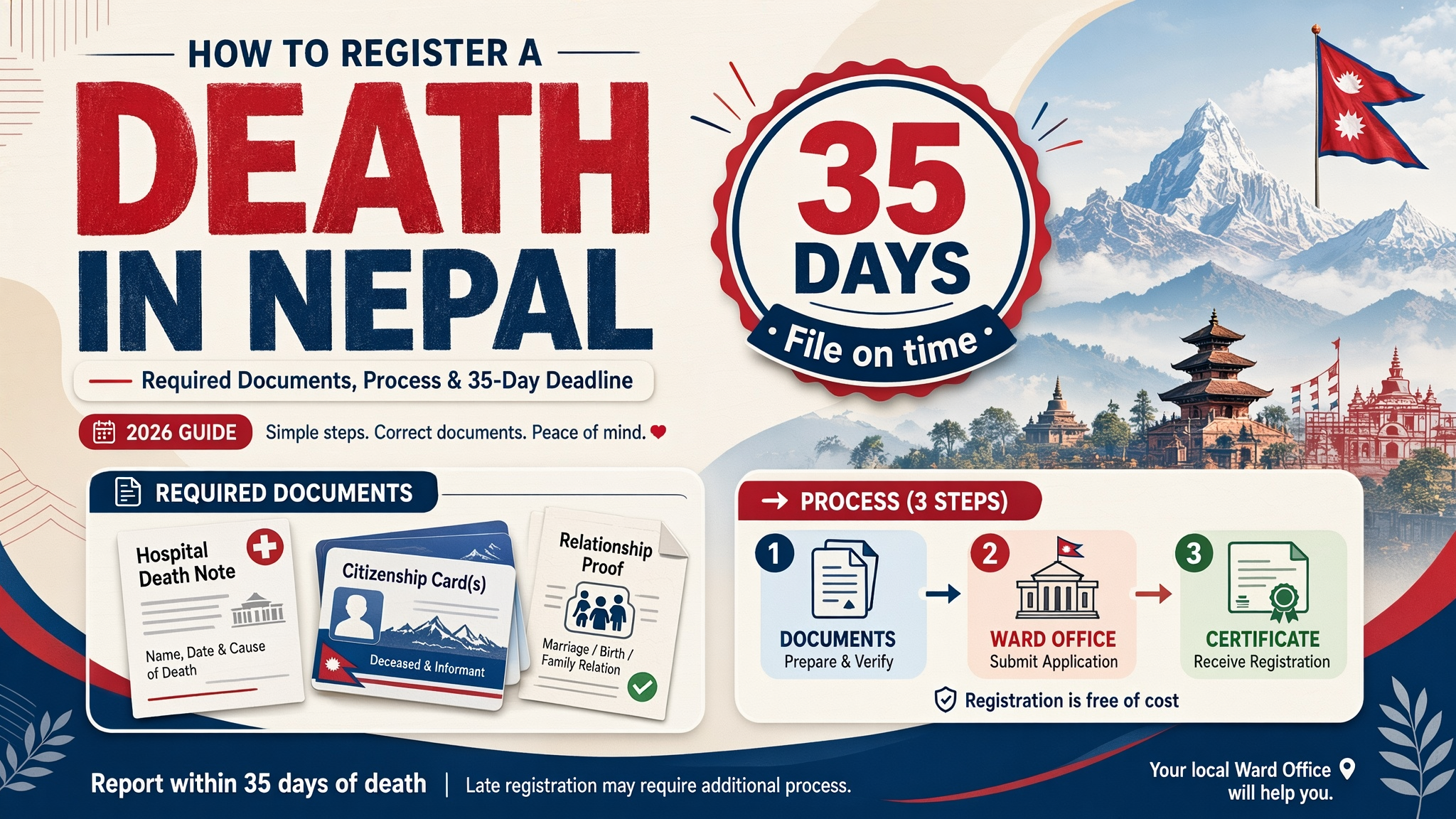
# How to Register a Death in Nepal: Required Documents, Process & 35-Day Deadline (2026)
In Nepal, a death must be reported to the local registrar — usually the ward office — within 35 days of the death. Registration is generally free within this period; after 35 days, a late fee applies.
This guide explains who can report a death, which documents you need, how to register at the ward office, and why the death certificate is essential for insurance, bank, pension, and inheritance matters.
Where to Register a Death
Register the death at the ward office or local registrar office where the deceased person was born or permanently resided. In urban areas, this is usually the municipality or metropolitan city office; in rural areas, it is the rural municipality or ward office.
The ward secretary acts as the local registrar, and the ward chairperson signs the death certificate after registration.
Who Can Report a Death?
The Department of National ID and Civil Registration's registration FAQs list death-registration informants as the father, mother, husband, wife, son, or daughter of the deceased — and, in their absence, another adult family member aged 18 or above.
The informant must provide their own citizenship certificate or valid identification.
Documents Required for Death Registration
Take both originals and photocopies where available. Exact requirements can vary slightly by local level, but commonly include:
| Document | Who provides it |
|---|---|
| Death registration application or notice form | Informant |
| Medical death report or cause-of-death document | Hospital, clinic, or treating health institution |
| Deceased person's citizenship certificate | Family member or informant |
| Informant's citizenship certificate or valid ID | Informant |
| Relationship proof | Family member reporting the death |
| Marriage certificate | If the deceased was married and the document is relevant. Our marriage registration guide covers obtaining one |
| Birth certificates of children | If required for family-record verification |
| Police report or post-mortem report | If the death was accidental, suspicious, or legally investigated |
| Cremation or burial document | If the ward office asks for it |
If the person died in a hospital or health institution, collect the death report from that institution before going to the ward office — the department's FAQ guidance lists the health institution's death report as a key document.
Step-by-Step: Death Registration Process
- Collect the medical death report. If the death occurred in a hospital or clinic, obtain the death report or cause-of-death document from the health institution.
- Identify the correct ward office. Go to the ward office where the deceased person was born or permanently resided.
- Fill in the death-information form. Provide the deceased person's full name, date of death, place of death, age, citizenship details, and family information.
- Submit documents. Give the medical death report, deceased person's citizenship, informant's citizenship, and relationship proof.
- Pay any applicable fee. Registration is free within 35 days. After 35 days, pay the late fee set by the local level.
- Receive the registration record. The ward office records the death in the vital-events register.
- Collect the death certificate. Check the deceased person's name, date of death, registration number, official seal, and signature before leaving.
35-Day Deadline and Late Fees
A death should be registered within 35 days of the date of death. Registration within this period is generally free.
After 35 days, late registration is still possible, but the local registrar charges a late fee. According to GOV.UK's Nepal knowledge-base profile (updated October 2026), Nepal applies two different penalty fees for late registration, depending on whether it is more or less than 70 days after the date of death. The exact amounts are administered by the local level, so they can vary between municipalities and rural municipalities.
| Timing | Fee |
|---|---|
| Within 35 days of death | Free |
| After 35 days | Late fee applies |
| After around 70 days | Typically a higher late fee, per external guidance |
| Exact amounts | Set by the local ward office or municipality |
Do not delay registration because of the late fee. Without a death certificate, families can face serious delays in insurance claims, bank-account settlement, pension transfer, and inheritance work.
What If the Death Happened in Another District?
If the death occurred away from the deceased person's permanent address, confirm with the ward office where the death occurred and the ward office of permanent residence.
The U.S. Department of State's Nepal civil-documents guidance says registrants should submit the form to the appropriate office where the deceased person was born or resided.
If you are unsure, call the ward office of the deceased person's permanent address first. They can tell you whether to register locally where the death occurred or obtain a transfer/reference document first.
What If the Death Happened Abroad?
If a Nepali citizen dies abroad, the family should contact the nearest Nepali embassy or consulate. The mission can guide the family on local death documentation, attestation, and bringing the record to Nepal for registration or verification.
For later use in Nepal, families may need the foreign death certificate, passport or citizenship documents of the deceased, and attestation or translation as required. Nepali missions provide attestation and verification services for death certificates and related documents — for example, the Embassy of Nepal in Beijing lists death certificates among the documents it attests, and our MOFA document attestation guide covers attestation from the Nepal side.
Why a Death Certificate Matters
A death certificate is official proof that a person has died. Families commonly need it for:
- Life-insurance and accident-insurance claims.
- Bank-account settlement and fund transfer.
- Social Security Fund or pension matters.
- Government allowances that depend on the death of a spouse or guardian — such as the social-security allowances covered in our allowance rates guide.
- Property ownership and inheritance processes.
- Updating family records and civil-registration records.
- Legal proceedings and government benefits.
- Closing subscriptions, memberships, and utility accounts.
The death certificate is the core document that connects the deceased person's legal and financial records to the fact of death. If the family also needs to move the family's civil-registration record after the death, the Basai Sarai migration certificate guide explains how the family record transfers between wards.
Common Mistakes to Avoid
- Waiting more than 35 days to visit the ward office.
- Not collecting the hospital death report before going to the ward.
- Using a different spelling of the deceased person's name from their citizenship certificate.
- Failing to bring the informant's citizenship or ID.
- Not keeping the registration receipt.
- Leaving the ward office without checking the certificate details.
- Assuming a cremation receipt alone is enough for legal or financial claims.
If a registered death certificate is later lost or damaged, you can get an official copy — our guide on duplicate birth, marriage or death certificates in Nepal covers the process, including the death-certificate documents ward offices commonly ask for.
Frequently Asked Questions
How many days do I have to register a death in Nepal?
You should register a death within 35 days of the date of death. Registration within this period is generally free.
Where do I register a death in Nepal?
Register at the ward office or local registrar office where the deceased person was born or permanently resided.
Who can inform a death registration?
The head of family, spouse, son, daughter, parent, or another eligible adult family member can report the death. The informant must provide identification.
Is a medical death report required?
If the death occurred in a hospital or health institution, collect the medical death report or cause-of-death document. For accidental, suspicious, or investigated deaths, police or post-mortem documents may also be required.
What is the late fee for death registration in Nepal?
A late fee applies after 35 days. The amount is set and collected by the local level, so confirm it with your ward office.
Can I register a death after several years?
Yes, late registration is allowed, but you may need additional evidence and must pay the applicable late fee.
Is a death certificate needed for an insurance claim?
Yes. Insurance companies generally require a death certificate to process a life-insurance or accident-insurance claim.
What should I do if a Nepali citizen dies abroad?
Contact the nearest Nepali embassy or consulate for guidance on local documentation, attestation, and use of the death record in Nepal.
Frequently asked questions
How many days do I have to register a death in Nepal?
You should register a death within 35 days of the date of death. Registration within this period is generally free.
Where do I register a death in Nepal?
Register at the ward office or local registrar office where the deceased person was born or permanently resided.
Who can inform a death registration?
The head of family, spouse, son, daughter, parent, or another eligible adult family member can report the death. The informant must provide identification.
Is a medical death report required?
If the death occurred in a hospital or health institution, collect the medical death report or cause-of-death document. For accidental, suspicious, or investigated deaths, police or post-mortem documents may also be required.
What is the late fee for death registration in Nepal?
A late fee applies after 35 days. The amount is set and collected by the local level, so confirm it with your ward office.
Can I register a death after several years?
Yes, late registration is allowed, but you may need additional evidence and must pay the applicable late fee.
Is a death certificate needed for an insurance claim?
Yes. Insurance companies generally require a death certificate to process a life-insurance or accident-insurance claim.
What should I do if a Nepali citizen dies abroad?
Contact the nearest Nepali embassy or consulate for guidance on local documentation, attestation, and use of the death record in Nepal.
Try the free tools
Put this guide to work — every Solutions Nepal tool is free and needs no signup.