
Quick Answer: How Credit Cards Work
A credit card lets you make eligible purchases up to a bank-approved limit and repay the amount later. If your card provides a grace period for purchases, paying the full statement balance by the due date may avoid purchase interest for those transactions. Paying only the minimum generally leaves a balance on which interest and other charges may apply.
Rates, fees, limits, payment dates, and foreign-use rules are issuer- and product-specific and may change. Check the current fee schedule and card agreement before applying or using the card. Nepal Bank’s published domestic-card terms are one bank example, not a universal schedule.
Credit and Card Types in Nepal
- Domestic credit card: Credit facility for transactions allowed by the issuer, card network, and current rules. Domestic cards can have restrictions on geography and transaction type.
- Foreign-currency or USD card: A bank-issued product for eligible foreign-currency transactions under current Nepal Rastra Bank (NRB) rules and issuer procedures. Eligibility and permitted use can be restricted.
- Prepaid foreign-currency card: You load eligible funds before spending. It is not the same as a revolving credit card and does not necessarily have the same limits or use conditions.
- Deposit-secured card: Some banks may issue a card against an eligible fixed deposit or other collateral. The bank sets the lien, limit, and release conditions.
These are broad product categories. Verify eligibility, permitted transactions, currencies, and fees with the issuing bank. For permitted international-payment options, see our guide to PayPal availability and online payments in Nepal.
Common Credit Card Fees
Depending on the card, the issuer may charge:
- Joining or issuance fee
- Annual or renewal fee
- Replacement-card or PIN-reissue fee
- Late-payment fee
- Over-limit or limit-enhancement fee
- Cash-advance fee
- Foreign-currency conversion or cross-border transaction charges
- Interest on outstanding balances or cash advances
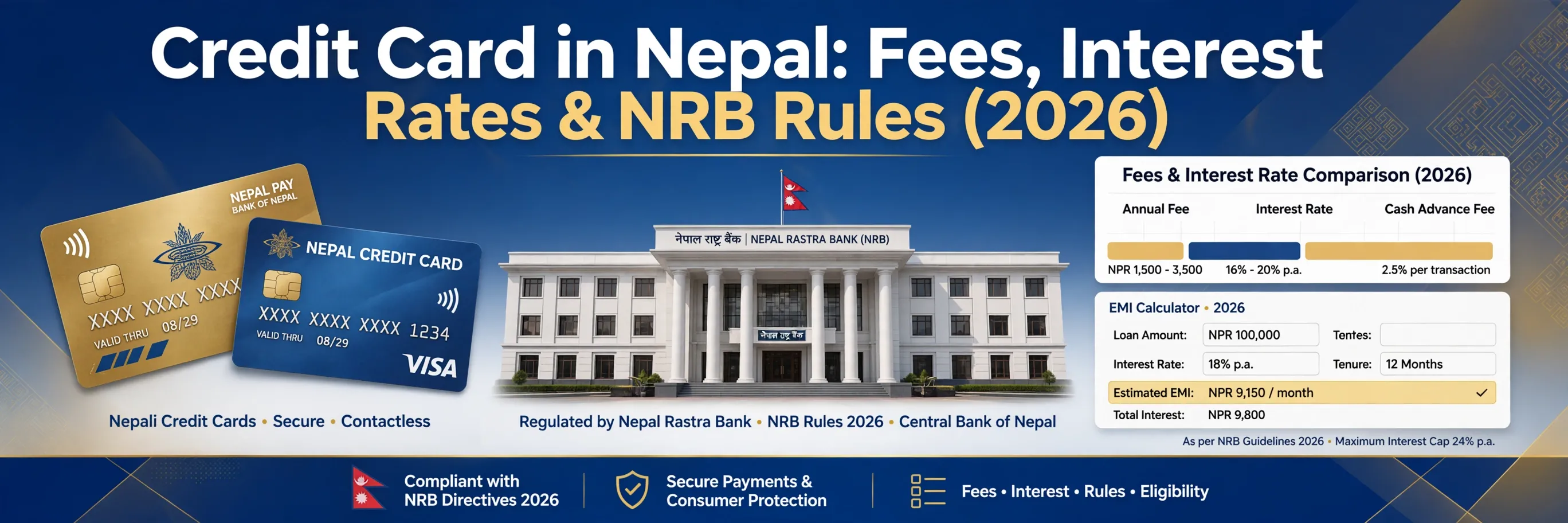
Fees differ across issuers and can change. As one dated example, Nepal Bank’s published Visa domestic-card schedule lists an issuance fee of Rs. 750, annual fee of Rs. 750, replacement fee of Rs. 750, PIN reissue fee of Rs. 50, late-payment fee of Rs. 300 per instance, and over-limit fee of Rs. 500. Its page states that charges are subject to change. Check the bank's current credit-card terms and fee schedule before relying on any amount.
Interest, Billing Dates, and Grace Periods
The interest rate and how it is calculated are set out in your issuer’s terms. For illustration, Nepal Bank currently publishes a 2% monthly rate for its domestic Visa card. That is a bank-specific example, not a market-wide rate. A monthly rate multiplied by 12 is a simple nominal comparison; the actual amount charged depends on the bank’s calculation method, transaction dates, fees, and repayment.
Some cards provide an interest-free period on eligible purchases when the full statement balance is paid by the due date. The length of that period, statement date, due date, and treatment of new transactions depend on your card agreement. Cash advances and other transaction types may not receive the purchase grace period.
Read each statement and confirm:
- Statement closing date and payment due date
- Full statement balance and minimum amount due
- Purchase-interest calculation and any grace-period conditions
- Cash-advance interest and fees
- How payments are allocated among balances
Minimum Payment: What It Does and Does Not Do
The minimum payment is the smallest amount the issuer requires by the due date to keep the account from becoming past due under its rules. It is not the same as paying off your purchases and usually does not prevent interest from accruing on the remaining balance.
For example, if a statement shows Rs. 50,000 due and the bank requires a 10% minimum, paying Rs. 5,000 leaves Rs. 45,000 unpaid before any applicable interest and fees. The actual minimum formula is defined by your issuer; check your statement rather than assuming a fixed percentage or rupee amount.
Cash Advances and Withdrawal Limits
Withdrawing cash on a credit card is usually more expensive than making a purchase. The issuer may charge a cash-advance fee and interest may begin immediately or follow a separate schedule, without the purchase grace period.
Cash withdrawal limits are subject to current NRB rules, issuer policies, ATM limits, and available credit. Nepal Bank states that its product limit is as per the NRB directive and publishes a limit of 10% of the card limit; confirm the latest rule and your card’s available cash limit with your bank before withdrawing.
Use a debit card or bank transfer for cash when practical. If you must take a cash advance, ask the bank for the total fee and interest calculation first.
NRB Rules and Foreign-Currency Spending
NRB directives and circulars can set or change requirements for card issuance, cash advances, foreign-currency spending, and electronic transactions. The applicable rules may depend on the card type, account, customer eligibility, transaction purpose, and current circular.
Do not assume that a USD 2,000 annual online-spending limit, a USD 500 virtual-card limit, a wallet top-up restriction, or any other number quoted online applies to your card today. Verify the current NRB notice and your bank’s written instructions before planning a foreign-currency transaction.
To check a card:
- Confirm with the issuer whether it is domestic, international, foreign-currency, or prepaid.
- Ask which transactions and merchants are allowed under current NRB rules.
- Check any annual or transaction limit, required documents, fees, and exchange-rate margin.
- Keep the bank’s written guidance and transaction receipts.
Consult Nepal Rastra Bank for current notices and your bank for how those rules apply to its product.
How to Apply for a Credit Card
- Compare card types and check whether you need domestic or eligible foreign-currency use.
- Read the issuer’s current interest, fee, repayment, eligibility, and limit terms.
- Prepare the documents requested by the bank. These may include identity documents, a photograph, salary or business-income evidence, bank statements, PAN or tax documents, or collateral details.
- Submit the application through the bank’s official website or branch.
- Respond to any verification request and wait for the bank’s credit assessment.
- Review the approved limit, statement date, payment due date, and cardholder agreement before activation.
- Set transaction alerts and secure the PIN and online banking access.
Some banks may assess applicants using non-salary income or offer a card secured against an eligible deposit. These options and the required documents are bank-specific. Nepal Bank’s application page, for example, describes its own eligibility, document, and deposit-lien terms; do not assume another bank follows the same rules.
How to Reduce Interest and Fees
- Pay the full statement balance by the due date whenever possible.
- Avoid cash advances unless necessary, and check their cost first.
- Set a reminder or bank alert for the statement and payment dates.
- Review every transaction and report unfamiliar charges to the issuer promptly.
- Keep spending within a repayment plan rather than treating the limit as income.
- Ask whether an annual fee can be waived and what conditions apply.
- Contact the bank early if you may miss a payment; ask for the amount due and available options.
- Never share your PIN, password, or OTP with a caller or someone claiming to be bank staff.
When a Credit Card May or May Not Suit You
A credit card may be useful for purchases and emergencies when you can track spending and repay on time. It may not suit you if you expect to carry a balance, need cash regularly, or do not have a realistic repayment plan. Interest and fees can make short-term borrowing expensive.
Before deciding, compare the cost of the card with alternatives and consider whether a debit card or a deposit-secured product better fits your needs. A credit card does not guarantee approval, improve a credit record automatically, or provide free borrowing when a balance remains unpaid.
Before Applying or Using the Card
- Confirm the card type, eligible transactions, and usage geography.
- Check the current joining, annual, cash-advance, late, and foreign-use fees.
- Read the interest rate, grace-period conditions, minimum-payment formula, statement date, and due date.
- Ask the bank to explain any cash or foreign-currency limits under current NRB rules.
- Understand any deposit lien and what is required to release it.
- Enable transaction alerts, protect credentials, and report a lost card immediately.
- Pay the full statement balance when possible and review each statement.
Official Sources and Final Note
For current regulatory notices, consult Nepal Rastra Bank. For product terms, fees, eligibility, and repayment calculations, consult the issuing bank’s current card agreement and fee schedule. Nepal Bank’s credit-card page is included as one bank-specific example only.
Last updated: November 7, 2026. NRB rules, bank charges, interest rates, and product limits may change. Confirm the current terms directly with NRB and your card issuer. This guide provides general information, not financial advice or a bank offer.
Frequently asked questions
What is the credit-card interest rate in Nepal?
It varies by bank and product and can change. For example, Nepal Bank publishes a 2% monthly rate for its domestic Visa credit card; check your issuer's current schedule and card agreement.
How much is the annual credit-card fee in Nepal?
Fees differ by issuer and product. Check the latest fee schedule for joining, annual, replacement, late-payment, over-limit, cash-advance, and other charges before applying.
What credit limit can I get?
The issuer sets the limit based on its product rules, income or collateral, repayment capacity, and credit assessment. Nepal Bank publishes a product-specific domestic-card range; other issuers may use different limits.
How much cash can I withdraw from a credit card?
Cash-advance limits depend on current NRB rules, issuer policy, and your available credit. Nepal Bank states that its cash-withdrawal limit follows the NRB directive and publishes a 10% limit for its product; verify the current rule and your card limit.
Do credit-card purchases have an interest-free period?
Some cards offer a grace period for eligible purchases if you pay the full statement balance by the due date. The period and eligible transactions vary. Cash advances commonly have separate fees and interest terms.
If I pay the minimum amount due, do I avoid interest?
Usually not. The minimum keeps the account from being treated as unpaid under the issuer's terms, but interest may continue on the remaining balance. Pay the full statement balance when possible.
Can I use a Nepali credit card on foreign websites?
Only if your particular card and account are eligible for the international transaction and the use is allowed by current NRB rules. Domestic cards, USD cards, and prepaid foreign-currency cards have different terms.
Can I get a credit card without a salary slip?
Some issuers may assess other income or offer a card secured against an eligible deposit. Requirements, collateral, and limits are bank-specific; ask the issuer directly.
What happens if I miss a payment?
The issuer may charge fees or interest and may report account conduct under applicable rules. Contact the bank promptly to understand the amount due and options; do not ignore overdue notices.
Try the free tools
Put this guide to work — every Solutions Nepal tool is free and needs no signup.